Should You Use AI-Generated Shopify Product Descriptions for SEO? Best Practices to Avoid Thin or Duplicate Content

AI has changed how ecommerce teams create product content. For Shopify stores with dozens, hundreds, or even thousands of SKUs, AI-generated product descriptions can dramatically reduce the time required to populate a catalog.
But speed creates a new SEO question: Are AI-generated Shopify product descriptions actually good for SEO, or can they create thin, repetitive, or duplicate content that holds your product pages back?
The short answer is yes, you can use AI-generated product descriptions for Shopify SEO—but treat AI as a drafting and scaling tool, not a replacement for strategy or human review.
The real risk isn’t just that AI wrote your descriptions. The bigger issue is pushing out hundreds of pages that all sound the same, add little original value, repeat manufacturer copy, or fail to give shoppers the details they need to convert.
A better approach combines AI efficiency with product-specific information, targeted keywords, human editing, strong internal linking, and regular SEO audits.
Here's how to do it.
Are AI-Generated Shopify Product Descriptions Good for SEO?
AI-generated product descriptions can boost your Shopify SEO if they're unique, accurate, useful, and based on real product details and what shoppers are actually searching for.
AI can help you:
- Create first drafts quickly.
- Describe at scale across large catalogs.
- Incorporate relevant keywords naturally.
- Translate technical specifications into benefits that customers can easily understand.
- Make the formatting consistent across all product pages.
- Develop meta titles and descriptions.
- Refresh outdated product content.
However, simply entering a product name into an AI tool and publishing the output isn't an SEO strategy.
Imagine a store selling 300 variations of similar products. If every page uses the same structure, identical selling points, and nearly identical language—with only the product color or size changed—the catalog may provide very little unique value.
The goal is AI-assisted product content, not AI-generated copy with zero human input. That’s how you protect your rankings and your revenue.
How Google Treats AI Content and Duplicate Product Descriptions in 2026

One of the biggest misconceptions surrounding AI SEO is that using AI automatically results in a Google penalty.
The more important question is whether your content provides useful information for users.
AI-generated content becomes an SEO concern when it contributes to low-quality experiences—for example, pages that are generic, repetitive, inaccurate, or created primarily to manipulate search rankings.
The same principle applies to duplicate product descriptions.
Duplicate content isn't necessarily a manual penalty
Many ecommerce stores use manufacturer-provided descriptions, supplier specifications, or similar descriptions across related products. Duplicate or substantially similar content doesn't automatically mean your Shopify store will receive a manual penalty.
The bigger issue is search visibility.
When search engines encounter multiple pages with very similar information, they may struggle to determine which page provides the most useful result. Similar pages can compete with one another, and search engines may show only one or a limited number of substantially similar results.
Copying a manufacturer’s description word-for-word might save time, but it gives your store almost no chance to stand out or win more customers.
What does thin content mean for product pages?
Thin content isn't simply content that has a low word count.
A short product description can be perfectly useful if the page provides strong product information, specifications, images, pricing, reviews, shipping details, and other information customers need.
A product page becomes more problematic when it offers little original or useful information.
For example:
“This stylish black handbag is perfect for everyday use. It is high quality, durable, and fashionable.”
That description could apply to hundreds of handbags.
A stronger description explains what makes the specific product different, who it's for, how it can be used, what materials it contains, what problem it solves, and why a shopper should consider it.
When AI Product Descriptions Help—and When They Hurt Shopify SEO
AI is especially useful when your catalog is large and manually writing every description would take significant time and resources.
AI works well for:
Large catalogs: Stores with hundreds of SKUs can use AI to generate consistent first drafts.
Variant-heavy products: AI can help organize product information when products have multiple attributes, as long as the resulting pages aren't unnecessarily repetitive.
Low-margin products: When a SKU doesn't justify hours of manual copywriting, AI can provide a starting point that an editor improves.
Content refreshes: AI can help identify outdated wording and restructure existing descriptions.
Feature-to-benefit conversion: AI can turn technical specifications into wording shoppers can easily understand.
AI becomes risky when:
Products are commoditized. If dozens of stores sell the same item and rely on the same manufacturer information, generic AI copy won't create meaningful differentiation.
Manufacturer copy is used as the only input. AI may rewrite existing content without introducing genuinely useful information.
Every variant receives almost identical copy. Changing “blue” to “red” isn't enough to create meaningful content differentiation.
Descriptions are generated without product verification. AI can make assumptions or introduce claims that aren't supported by the actual product.
The primary goal is keyword insertion. Keyword-heavy copy can sound unnatural and doesn't necessarily improve rankings or conversions.
The safest approach is to give AI more useful information to work with, not less.
Best Practices for SEO-Friendly AI-Generated Shopify Product Descriptions

1. Create unique content for every meaningful product
Don't ask AI to rewrite the same template 500 times.
Instead, just provide inputs that are specific to each product, for example:
- Product name
- Materials
- Dimensions
- Color
- Features
- Use cases
- Target customer
- Key benefits
- Care instructions
- Warranty information
- Information about shipping or availability.
- Brand differentiators
- Relevant customer concerns
The more detailed the source information you provide, the more helpful the resulting description will be.
For example, instead of prompting:
“Write an SEO description for a cotton T-shirt.”
Give the model detailed product information and ask it to explain how the product differs and why it's useful to the intended shopper.
2. Add the keywords in a natural way
Your product page needs one clear main keyword plus a few supporting terms, but you don't have to stuff them into every sentence.
Here's what a workable keyword framework could look like:
- Primary keyword: the main product or search phrase
- Secondary keywords: closely related searches.
- Semantic terms: attributes, materials, uses, problems, or characteristics associated with the product
- Use commercial modifiers, such as "for women," "organic," "wireless," or "waterproof," only when they are genuinely relevant.
Use important terms naturally in the product title, description, headings where appropriate, image alt text, metadata, and supporting content.
Avoid writing for a keyword density percentage. Write for the shopper first.
3. Lead with the customer benefit
Don't make shoppers read a whole paragraph of specs before they understand why the product deserves their attention.
Start with the most compelling benefit.
Then explain how the product delivers that benefit.
For example:
Feature: Lightweight construction.
Weak copy: “This product has a lightweight construction.”
Better copy: “Designed for comfortable all-day use, the lightweight construction makes it easier to carry without sacrificing durability.”
AI can be particularly effective at turning technical features into customer-focused benefits—but you still need to verify those claims.
4. Use a scannable product-page structure
Online shoppers rarely read every word.
A useful structure can include:
Benefit-focused introduction
Briefly explain what the product is and who it is designed for.
Key features and benefits
Use bullets to make important information easy to scan.
Specifications
List dimensions, materials, weight, compatibility, sizes, and any other relevant technical details.
Use cases
Explain when, where, or how the product can be used.
Trust signals
Whenever it makes sense, add warranties, certifications, customer reviews, guarantees, or other valid trust signals.
This structure also gives AI a framework, rather than letting it produce an unstructured block of generic prose.
5. Optimize meta titles and descriptions separately
Your product description and metadata have different jobs.
The product description should persuade and inform the shopper.
The meta title should clearly communicate the product and relevant search intent.
The meta description should provide a concise reason to click.
For example, rather than generating the same generic metadata for every product, build templates that incorporate product-specific information while keeping the wording natural.
How to Avoid Thin and Duplicate Content at Scale
Scaling AI content requires a catalog-level strategy, not just a better prompt.
Separate parent products from variants
One common e-commerce challenge is deciding how much content each variant needs.
If multiple variants represent the same underlying product, creating hundreds of pages with identical descriptions may not add value.
Instead, determine whether a variant genuinely deserves its own searchable page.
If variants differ substantially in use, features, or search intent, give those differences appropriate visibility.
Where differences are minor—such as color alone—avoid creating artificial content to make pages appear unique.
Add information AI cannot invent
AI should work from your product data rather than filling gaps with assumptions.
Give it:
- Original product specifications
- Internal product notes
- Customer questions
- Reviews
- Unique selling points
- Brand positioning
- Expert knowledge
- Demonstrated use cases
- Product testing information
This gives you a description that's based on real business knowledge instead of generic ecommerce wording.
Build internal links around product intent
You shouldn't just let your product pages stand alone.
Set up connections between:
Product → Collection → Related products → Educational content
For example, a product page can link to its relevant collection page, complementary products, buying guides, or educational blog posts.
This helps shoppers discover related information while giving search engines additional context about how your site is organized.
It also creates a stronger content cluster around important product categories.
Use structured data correctly
Product structured data can help search engines understand product details, offers, availability, and other eligible attributes.
Don't think of schema as a replacement for good product content.
Instead, treat it as another way of communicating clear product information in a structured format.
Your visible page content, structured data, internal linking, and technical SEO should work together.
A Simple AI + Human Workflow for Shopify Product Copy
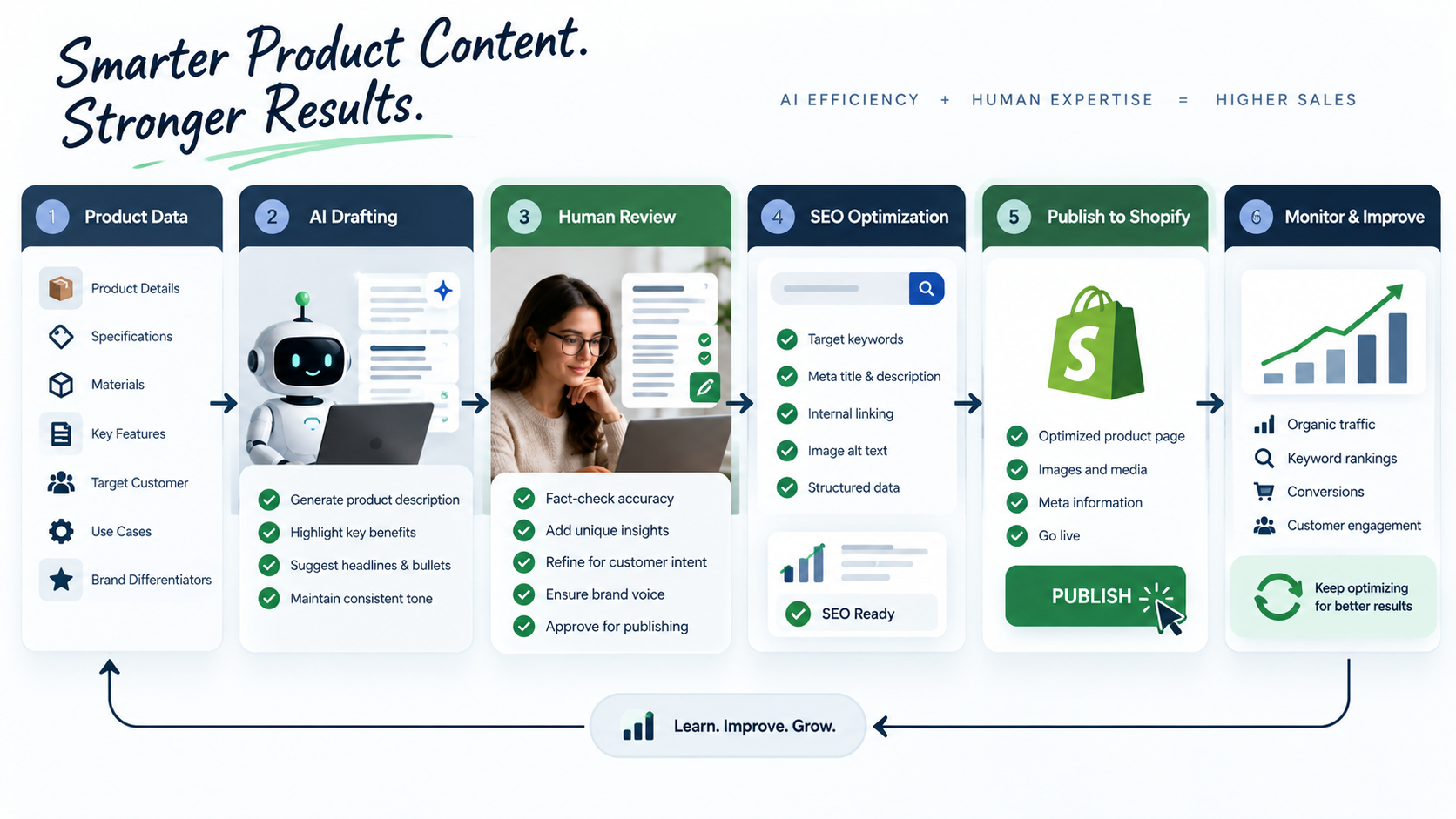
The most reliable approach is a repeatable workflow.
1. Collect product data
Pull product specifications, audience information, benefits, keywords, differentiators, and existing content into a structured input.
2. Generate the first draft
Make sure your AI prompt covers the target audience, tone, product information, SEO terms, required structure, and restrictions.
3. Conduct human review
Check every important factual statement.
Ask:
- Is everything accurate?
- Did AI make anything up?
- Does the copy reflect our brand?
- Is the product genuinely differentiated?
- Do the features actually support the benefits?
- Are the keywords natural?
- Is anything unnecessarily repetitive?
4. SEO enrichment
Review the main keyword, related terms, metadata, headings, internal links, image optimization, and structured data.
5. Publish as a draft first
For larger catalogs, avoid automatically publishing every AI-generated description.
Send content into a review queue so an editor can approve or revise it.
6. Audit performance
Once published, review organic clicks, impressions, rankings, indexing, conversions, and engagement.
This workflow can also connect to automation platforms such as Make.com, moving product information from your catalog into an AI drafting stage, then into Shopify as a draft for human approval.
The important principle is simple:
Automate repetitive work—not final judgment.
Quick Audit: Is Your AI Product Content Hurting SEO?
If you've already published AI-generated descriptions, you don't necessarily need to rewrite your entire catalog.
Start with an audit.
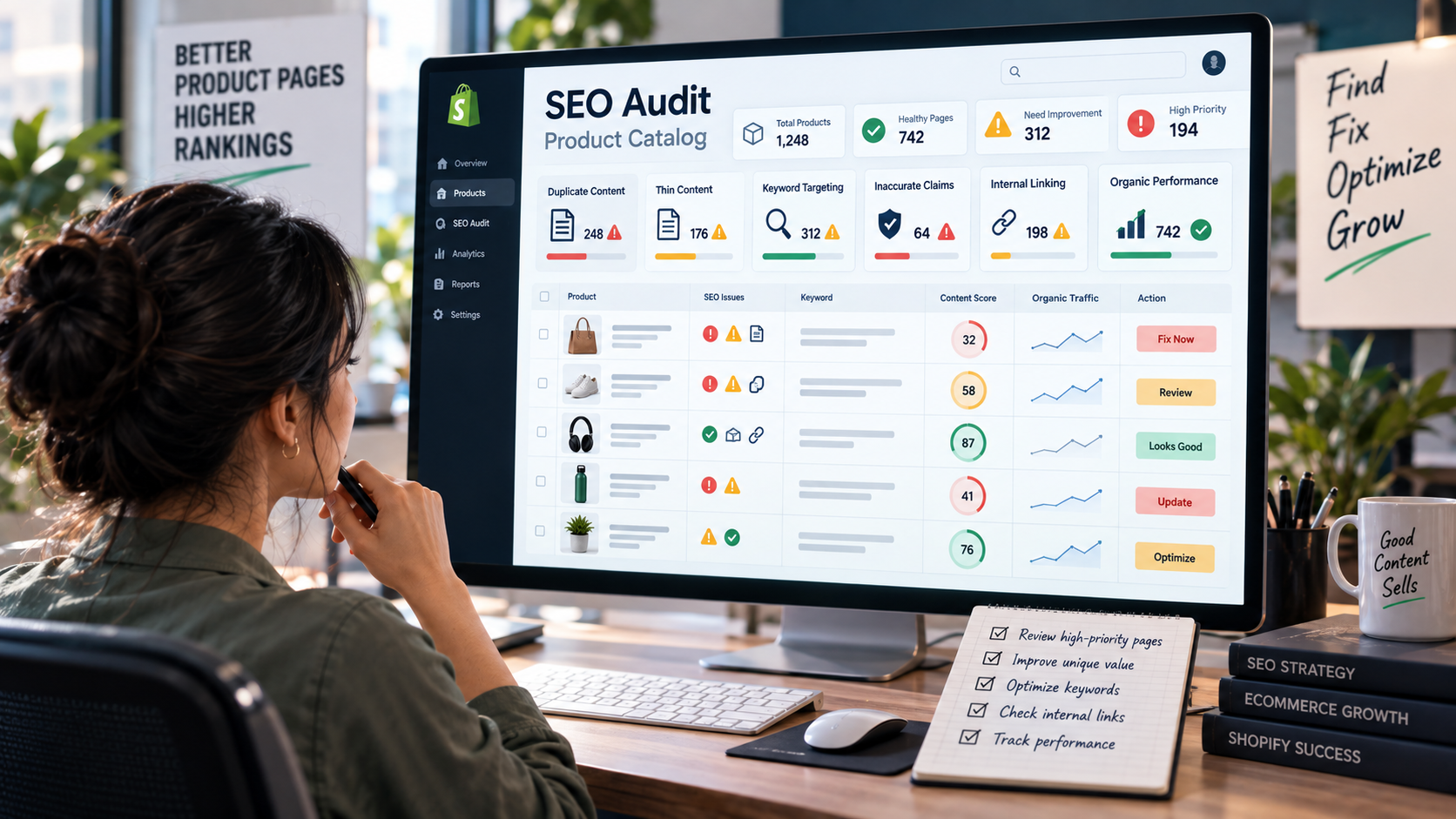
Shopify AI Product Description SEO Checklist
If resources are limited, prioritize products with search impressions but weak clicks, poor rankings, or low conversions.
These pages may offer the clearest opportunity to improve both SEO and the customer experience.
AI Product Description SEO: What to Do and What to Avoid
Do:
- Use AI to speed up drafting.
- Provide AI with detailed, accurate product information.
- Write genuinely differentiated descriptions.
- Target search intent in a natural way.
- Translate features into customer benefits.
- Keep product pages easy to scan.
- Check all significant factual claims.
- Create internal links among related pieces of content.
- Track organic performance after publishing.
- Review your catalog on a regular basis.
Don't:
- Publish raw AI output without review.
- Reuse manufacturer descriptions across multiple products.
- Copy manufacturer descriptions across products.
- Change only the product name or color to create “unique” content.
- Stuff keywords into descriptions.
- Let AI invent specifications or benefits.
- Create unnecessary variant pages.
- Assume more words automatically mean better SEO.
- Treat AI content as a set-and-forget process.
FAQs About AI Product Descriptions and Shopify SEO
Q1. Will Google penalize my Shopify store for using AI?
A. Using AI to create content does not automatically make a page bad for SEO. The important consideration is the quality and usefulness of the resulting content. The safest approach is to use AI as part of a controlled workflow with human review and product-specific information.
Q2. Is duplicate manufacturer copy a penalty?
A. Duplicate manufacturer content doesn't automatically trigger a manual penalty. However, relying heavily on identical content makes it harder for your product pages to stand out. Reworking the content around your product knowledge, customer needs, benefits, and differentiators can result in more useful pages.
Q 3. How long should a Shopify product description be?
A. No universal word count makes a product description SEO-friendly. The right length depends on the product and what shoppers need to know. A simple product may require relatively little copy, while a complex product may need detailed specifications, use cases, benefits, FAQs, and supporting information.
Focus on completeness and usefulness rather than hitting a specific word count.
Q4. Can I use the same AI tool for all my products?
A. Yes. The tool itself isn't the main issue. Your inputs, prompts, product data, review process, and content strategy matter more.
You can use one AI system across your catalog while still producing differentiated content by giving each product accurate, specific inputs and defining what makes each product unique.
Final Takeaway: Use AI to Scale Quality, Not Scale Similarity
AI-generated Shopify product descriptions can be a powerful SEO asset—but only when you use them strategically.
The biggest mistake is thinking that AI solves the product-content problem simply because it can produce thousands of words quickly.
It doesn't.
Your competitive advantage comes from the information, expertise, differentiation, and customer understanding you put into the process.
A strong Shopify AI content workflow looks like this:
Product data → AI draft → Human review → SEO enrichment → Publish → Performance audit
This method delivers AI efficiency while keeping your catalog from becoming a set of generic pages.
In an AI-shaped search landscape, that difference really matters. Your product pages should be clear for search engines, helpful for shoppers, and unique enough to earn attention.
If your Shopify catalog already holds AI-generated, duplicated, or thin product content, begin with an audit instead of rewriting everything at once. Start by finding the pages with the most search and conversion potential, fix those first, and then build a repeatable process for the rest of the catalog.
Want to turn AI-generated product content into a scalable SEO system? Consider a Shopify SEO and AI content audit with 253 media to identify thin pages, duplication, keyword opportunities, and workflow improvements across your store.