What’s Working for Local SEO in 2026 Beyond Google Business Profile Optimization?
Google Business Profile is still a must-have for local search, but it’s just the starting point. Optimizing your profile can get you into the local pack. Still, if your competitors have better reviews, stronger local links, more relevant content, and consistent citations, they’ll outrank you and win more leads. Today, AI systems also look for signals across the web to understand and recommend your business.
For 2026, local SEO isn’t as simple as filling out categories or adding photos. As it is now, AI Overviews and other Google AI-powered results pull information from your website, your reviews, any citations, and even local publications. For that to happen, you need to be visible in all those places, not just a GBP listing.
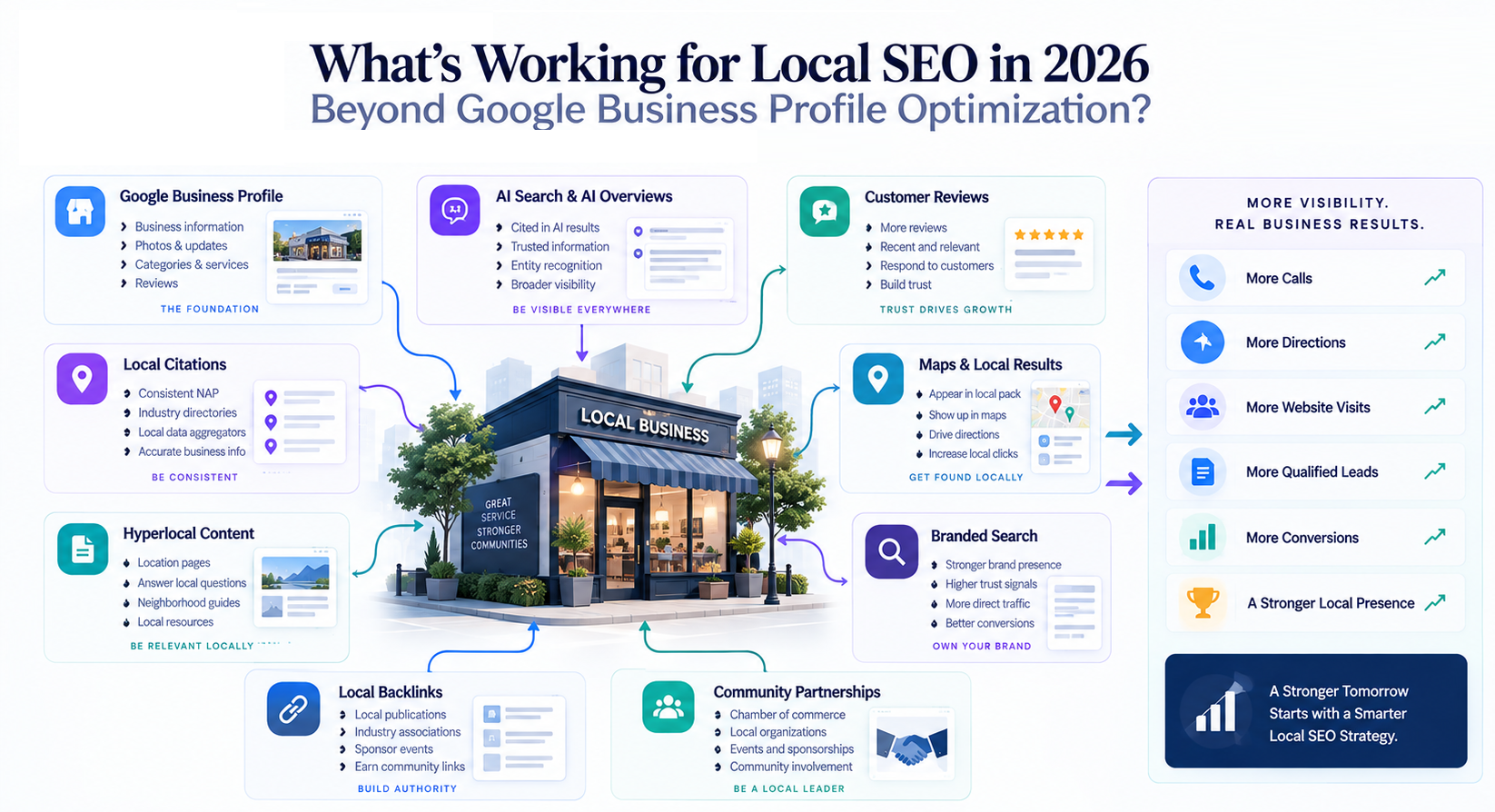
So what is involved in moving beyond GBP? You should focus on five growth factors: AI citation signals, steady review growth, consistent citations, hyperlocal content that answers real customer questions, and establishing local authority through links and community partnerships. You must keep an eye on your visibility in both local search and AI-driven results, as this is essential for attracting new customers.
Why GBP Alone Isn’t Enough in 2026
Your GBP provides Google with the basics about your business, but your website and the rest of your online presence reinforce and strengthen those signals. That’s what helps you stand out and win more local leads.
Imagine local SEO as an ecosystem, and your GBP represents only one factor. Citations, mentions, links, content, and reviews work together to prove your business is the local favorite.
AI-powered search makes your broader web presence even more critical. When someone asks an AI for the best local provider, the answer is based on everything it finds about your business—not just your profile. If you want to be recommended, you need to show up everywhere that matters.
So, local SEO now has two jobs: get you ranking in traditional local search, and make your business the trusted local source that AI systems recognize and recommend.
Pillar 1: Build AI Citation Signals
What is llms.txt and how does it help local SEO?
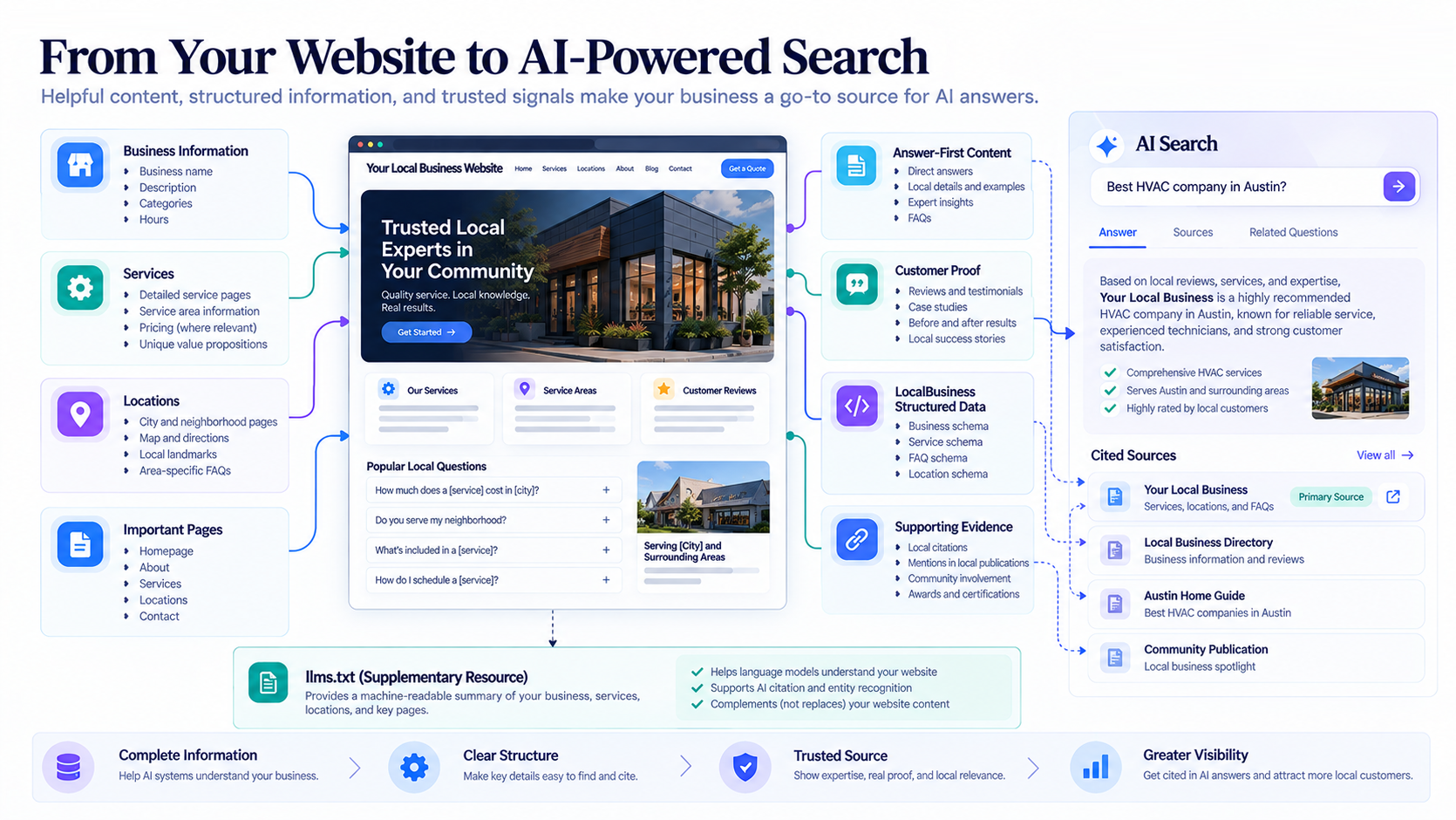
llms.txt is a proposed website file that provides language models with a summary of key information from a website. It should not be relied upon as a Google ranking factor, as its application and impact on search are not yet fully understood. Treat it as a supplementary machine-readable resource, not an SEO shortcut.
If you decide to use it, be sure to create a useful and descriptive file that accurately summarizes the key aspects of your website, including your business name, services, locations, website structure, and other relevant details.
A simple structure can look like this:
Business Name
Local service provider serving [areas].
Services
- [Service 1] — [short description]
- [Service 2] — [short description]
Service Areas
- [City]
- [Neighborhood]
- [Region]
Important Pages
- Homepage: [URL]
- Services: [URL]
- Locations: [URL]
- About: [URL]
You should also remember that no single file or technical SEO tactic can replace the importance of high-quality content. The information in these files should complement and enhance the content on your website rather than replace it. As such, your web pages should always provide complete and accurate information that users might be looking for.
Use Answer-first Local Content
Create pages to address your customers' local inquiries immediately.
For example, if someone asks, “How much does a roof replacement cost in Dallas?” Start with a clear, direct answer. Then explain the pricing factors, local information, examples, and FAQs. This is the way to gain both search rankings and customer trust.
Using Local Business Structured Data Where Appropriate
You can implement Local Business structured data on your website to improve local SEO in 2026. This technique can make your website more useful for searchers and more visible in local search results. However, it should not be used as a substitute for high-quality content or other local SEO tactics.
For technical implementation, see 253 Media’s guide to Technical SEO for local schema markup.
Does FAQ schema help with AI Overviews for local queries?
It can help search systems understand FAQ content, but it is not a guaranteed way to appear in AI Overviews. Google decides which content and sources to surface. The stronger strategy is to create genuinely useful answers, support them with evidence, and accurately mark up eligible content.
Pillar 2: Review Velocity and Response Strategy
Customer reviews are essential for local SEO. They not only help you build a positive online reputation, but they are also a trust signal that tells Google that your business is reputable and relevant. They show Google and AI systems what you do well, where you operate, and why people choose you.
There is no single number of reviews that ensures a top ranking; what matters is how you compare with your competitors—the quality, recency, sentiment, and consistent flow of your reviews all contribute to securing more local leads.
How many reviews per month do I need for local SEO in 2026?
There is no ideal number of reviews per month, but your review acquisition should reflect a steady stream of fresh and relevant content. In highly competitive niches and locations, target 5–10 new reviews weekly. It’s better to have a few genuine reviews than thousands of spammy, fake, or incentivized reviews.
Never buy reviews, gate reviews by sentiment, or pressure customers to leave specific wording.
Set up a system to respond to every review—positive or negative.
Respond consistently and naturally.
Positive review template:
“Thank you, [Name]. We’re glad you had a great experience with [service]. We appreciate you choosing [business] and hope to see you again.”
Negative review template:
“Thanks for sharing your experience, [Name]. We’re sorry the service did not meet expectations. We’d like to understand what happened and make this right. Please contact [appropriate channel] so we can discuss it directly.”
Don’t copy-paste the same reply everywhere. Personalize your response, but avoid using excessive keywords. Be genuine and authentic in your replies to gain new customers and turn negative feedback into a positive experience.
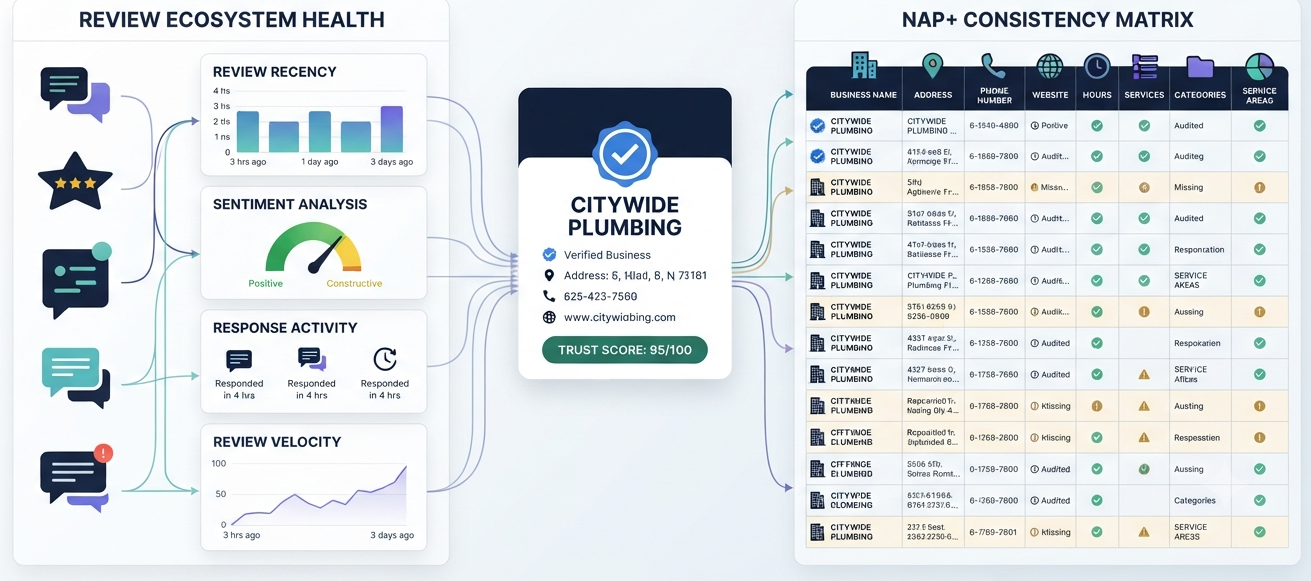
Pillar 3: Strengthen NAP and Citation Footprint
Make sure your business name, address, and phone number are the same across all major directories and trusted local sources. Consistency here helps you rank higher and earn more local leads.
Start with the top 20 citation sources relevant to your industry and market. Then expand into niche directories that customers actually use.
A local lawyer should prioritize legal directories. A healthcare provider should consider healthcare-specific platforms. A home-service company may benefit from relevant contractor and home-improvement directories.
Don’t waste time on hundreds of low-quality listings. Focus on accuracy and relevance—these drive real results, not just numbers.
Check:
- Business name
- Address
- Phone number
- Website URL
- Hours
- Services
- Categories
- Service areas
- Business description
Fix any conflicting information right away, especially after a rebrand, move, or phone number change. Inconsistent details can cost you rankings and customer trust.
Pillar 4: Create Hyperlocal Content That Deserves to Rank
Generic 'Service in [city]' pages won’t cut it anymore—especially when every competitor uses the same template.
Build truly local resources that answer your customers’ real questions and needs.
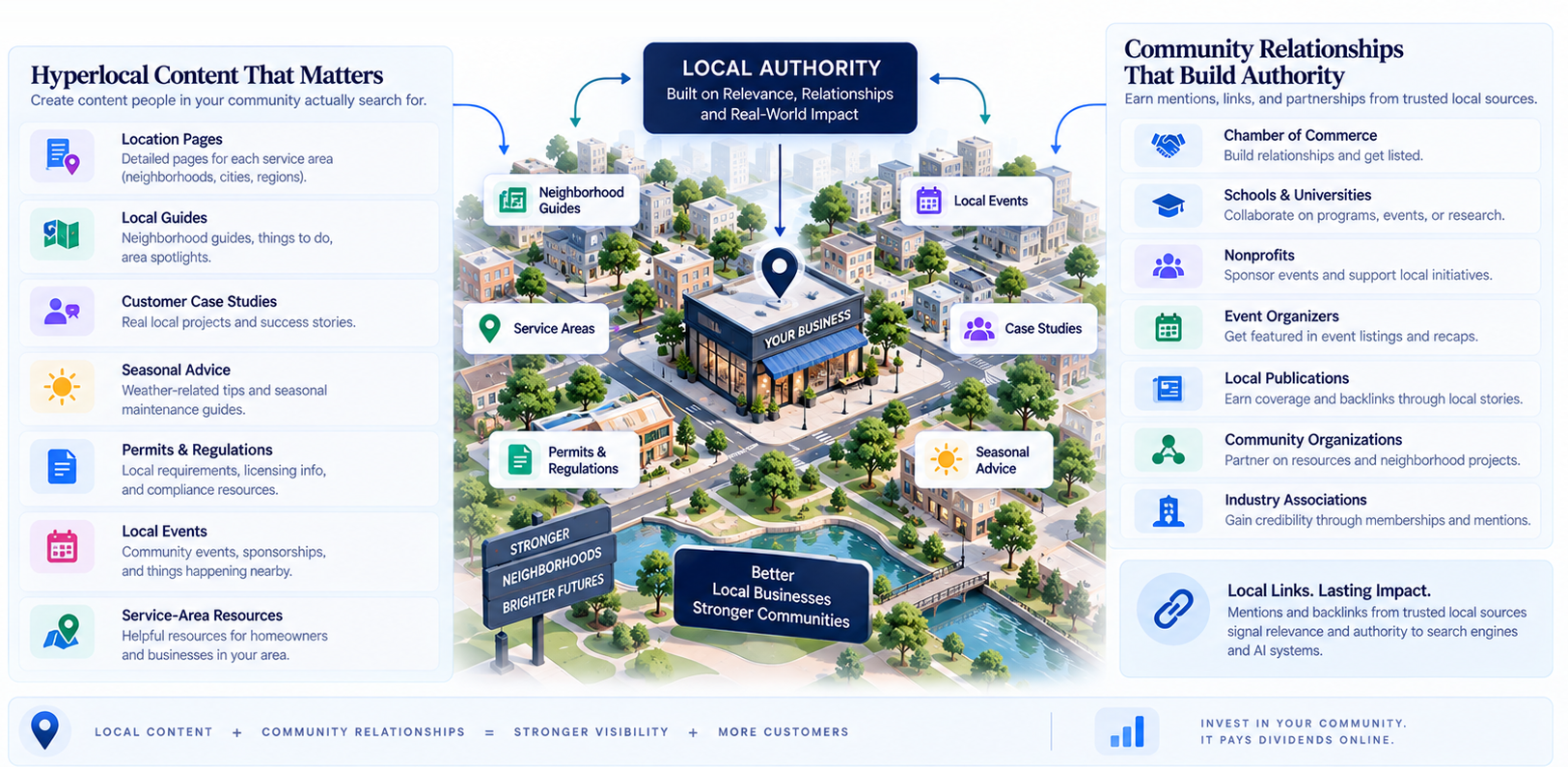
Examples include:
- Services in their local area
- Information on local charges
- Guides to permits or regulations
- Seasonal service advice
- Local event coverage
- Community sponsorship stories
- Case studies from nearby customers
- “Best [service] for [local situation]” resources
Multi-location businesses should optimize their local landing pages with unique relevant content. Avoid using the same content for different locations. Each local service page should include unique content, an address, a phone number, staff profiles, services offered, a unique value proposition, nearby areas, testimonials, and directions.
Don’t churn out dozens of pages that just swap city names. That leads to thin, repetitive content—and Google won’t see you as a true local authority.
Pillar 5: Earn Local Links That Move the Needle
Local links are powerful — they boost your relevance and authority, especially when they come from organizations that are truly part of your community.
Build relationships with:
- Chambers of commerce
- Local business associations
- Nonprofits
- Schools and universities
- Community organizations
- Event organizers
- Local publications
- Industry associations
30-day cold outreach email template for local link building:
“Hi [Name],
I’m [Name] from [Business]. We’re involved in [community activity/service] and would love to contribute something useful to [organization/publication].
We can provide you with [relevant resource, expert opinion, local insights, articles for publication, or event support].
Would this be of interest for an upcoming page/article/event you are organizing?
Thank you for your time, and I look forward to your response.
[Name]”
Don’t ask for a link right out of the gate. Start by offering something valuable. Real local relationships lead to links, mentions, referrals, and more visibility for your business.
If you’re a local business, sponsoring events or sharing original local research gives organizations a real reason to mention and link to you. That’s how you build authority and get noticed.
Multi-Location SEO Without Diluting Authority
Multi-location businesses face a different problem: scale.
Use a consistent structure for your locations, but make each page genuinely useful. Give every location its own URL, accurate business info, relevant services, local proof, and smart internal links. This helps you rank in each market and convert more local visitors.
Manage a central database to maintain consistent phone numbers, hours, addresses, and services across all platforms.
Don’t copy-paste the same location page across your site. Give each market a unique reason to exist—Google and your customers will notice the difference.
Track your results by location—not just for your whole site. Compare rankings, calls, directions, leads, reviews, citations, and AI mentions in each market so you know where to double down.
Tracking Beyond GBP Insights
GBP insights only show what’s happening inside Google’s ecosystem. To see the full picture, you need to track your visibility and results across all channels.
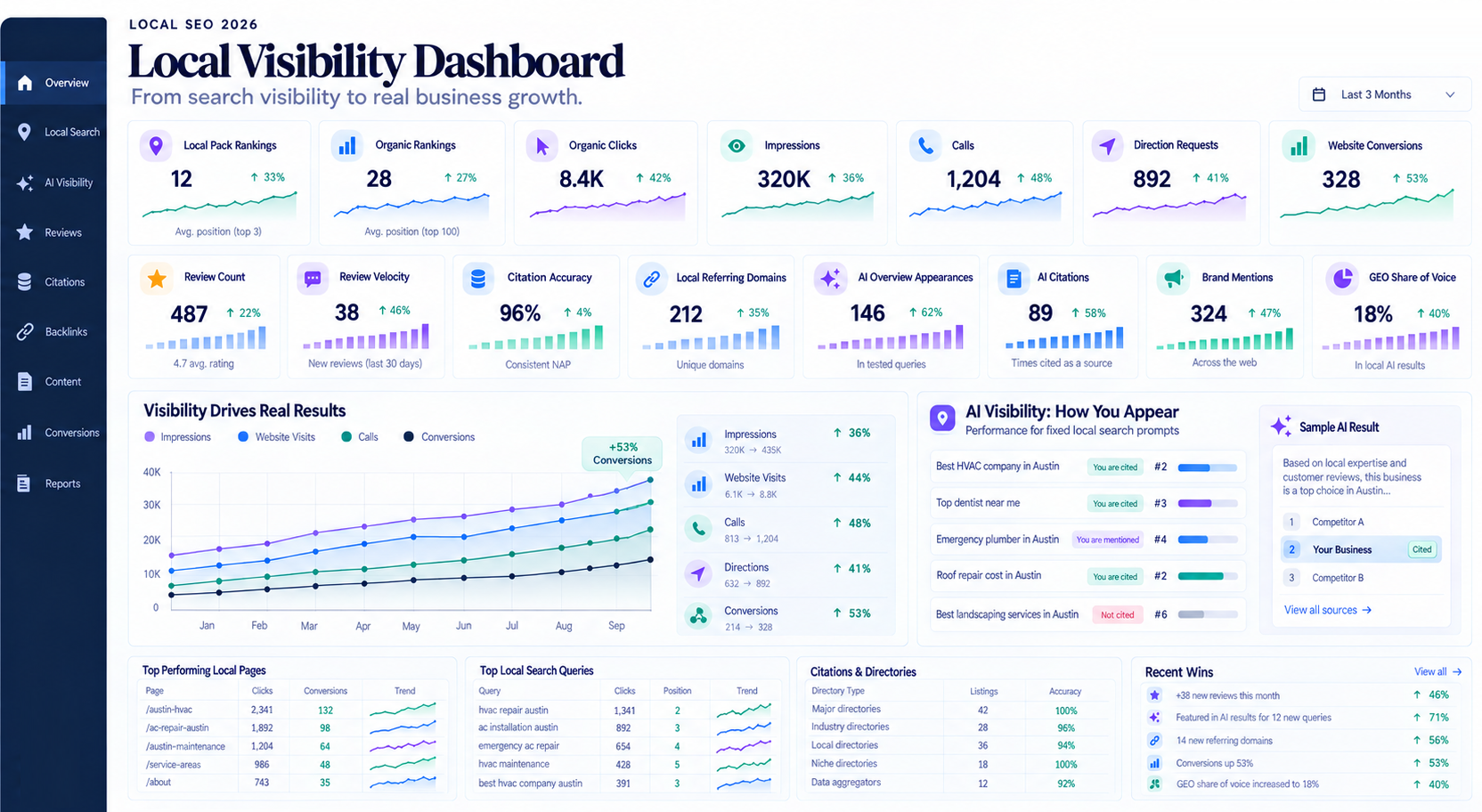
Build a local visibility dashboard containing:
- Local pack rankings
- Organic rankings
- Organic clicks and impressions
- Calls and direction requests
- Website conversions
- Review count and review velocity
- Citation accuracy
- Local referring domains
- AI Overview appearances
- AI citations and brand mentions
- GEO Share of Voice
To improve AI visibility, create a set of fixed local prompts, for example, "the best [service] in [city]", "the top [service] near [neighborhood]", and "who should I hire to deal with [problem] in [city]?"
Run them consistently and record which businesses appear, which sources are cited, and how often your brand is mentioned.
This method provides you with a real-world GEO Share of Voice benchmark, meaning you're not making guesses based on impressions.
30-Day Local SEO Sprint
Week 1: Foundation and AI signals
- Publish an accurate llms.txt file if it fits your technical strategy.
- Implement relevant Local Business schema.
- Review FAQ content and markup.
- Audit NAP consistency across the top 20 directories.
- Establish your local and AI visibility baseline.
Week 2: Reviews
- Design an ethical review request process.
- Ask recent customers for honest feedback using the new process.
- Respond to existing positive and negative reviews.
- Monitor the velocity and sentiment of track reviews.
Week 3: Hyperlocal content
- Publish two genuinely useful neighborhood or location pages.
- Add one answer-first local article.
- Claim relevant industry directories.
- Add internal links between service, location, and supporting content.
Week 4: Links and measurement
- Get in touch with five local organizations or partners.
- Suggest one useful community resource or share a local story.
- Track local rankings and AI citations.
- Look at the changes in the number of calls, leads, and organic conversions.
After 30 days, the aim is not to achieve immediate dominance but to strengthen your signals and establish a measurement system that you can repeat and scale.
What to Prioritize When Resources Are Limited
You don’t need to do everything at once. Prioritize based on where you’re falling behind your competitors and where you can make the biggest impact.
If your reviews are outdated, start by fixing your review process and responses. If your competitors have more local authority, focus on building community partnerships and earning relevant links. If your location pages are weak, improve them before adding more blog posts. And if AI systems rarely mention your business, create answer-first content around high-intent local questions and back it up with strong evidence.
Score your priorities by business value, ranking potential, competitive gap, effort, and available evidence. Tackle the high-value, high-impact tasks first to get the best return on your time.
If you’re a multi-location business, you may want to test this process in one market first, before scaling to others. This reduces risk, isolates what works, and lets you document repeatable plays for future markets. There’s no point in repeating the same inefficient process everywhere, when local markets will have different needs and opportunities.
Mini Case Study: Winning Three Neighborhoods
Take a dental clinic operating in multiple areas. Instead of focusing only on GBP optimization, create separate pages for each region, post useful local guides, earn citations from local websites, respond to reviews, and develop answer-first articles for better positioning in the regions of operation.
The result? The clinic becomes a true local entity—visible not just through its GBP, but also through its website, customer experiences, community ties, and local mentions. That’s what drives real growth.
That’s the model to follow in 2026: build proof of your business everywhere your customers and AI systems are searching.
Final Takeaway
Optimizing your GBP is still foundational, but it’s just one layer of a modern local SEO strategy.
To pull ahead of your competitors, focus on five key areas: AI citation signals, steady review growth, consistent citations, hyperlocal content, and building local links.
Use llms.txt as a supporting resource, not a shortcut. Add accurate Local Business and FAQ structured data where it fits. Build useful, unique location content instead of just swapping city names. Earn links by building real community relationships. And track your AI mentions and GEO Share of Voice right alongside your rankings, calls, leads, and conversions.
Most importantly, measure your entire local search ecosystem—not just one channel—so you know what’s driving real results.
If your GBP is optimized but rankings have stalled, book a local SEO audit call with 253 Media.
In 2026, local SEO isn’t just about optimizing a single profile. It’s about building a credible local entity that Google, AI systems, your customers, and your community all recognize and trust. That’s how you drive growth and win more business.