How Do You Optimize for Google AI Overviews and ChatGPT in 2026? An AIO Playbook for Zero-Click Search
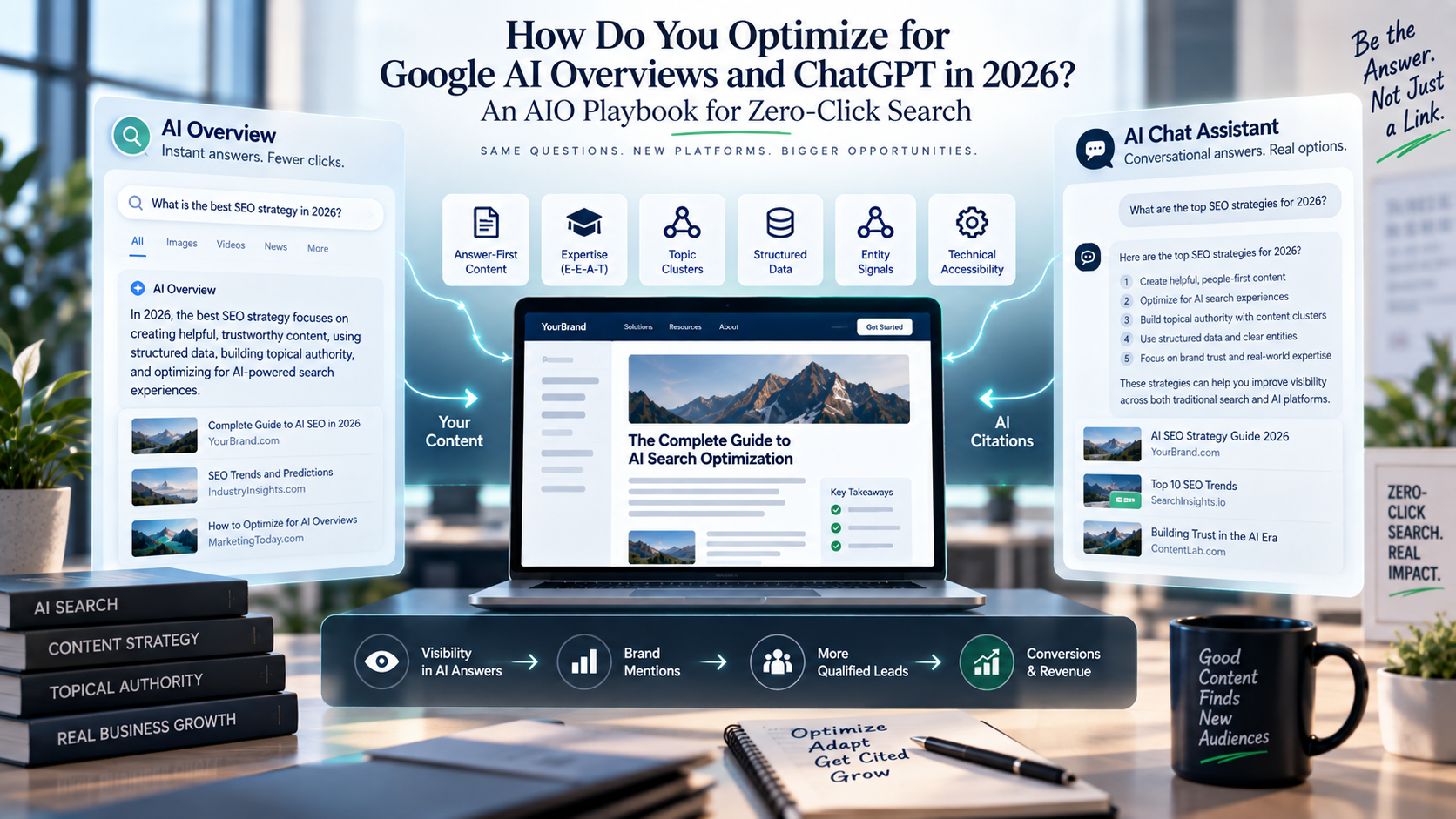
Search is no longer limited to blue links. Today, Google can answer your customer's question before they visit your site, and ChatGPT can compare providers or suggest solutions during a chat. This change means your SEO strategy should focus on becoming the trusted source these AI systems rely on, since that's what drives leads and conversions in 2026.
By 2026, just being visible isn't enough—you need to be clear, trustworthy, and the kind of source AI systems want to cite. It's not only about rankings anymore. Clicks aren't the whole story.
This playbook offers a practical framework to succeed with Google AI Overviews and ChatGPT. Create answer-first content, showcase your brand's expertise, build connected topic clusters, keep your site easy to access, and track citations alongside your organic traffic. Every step helps you get leads, drive more sales, and increase revenue, even if people do not click through to your site.
Why Zero-Click Search Is Eating Your Traffic
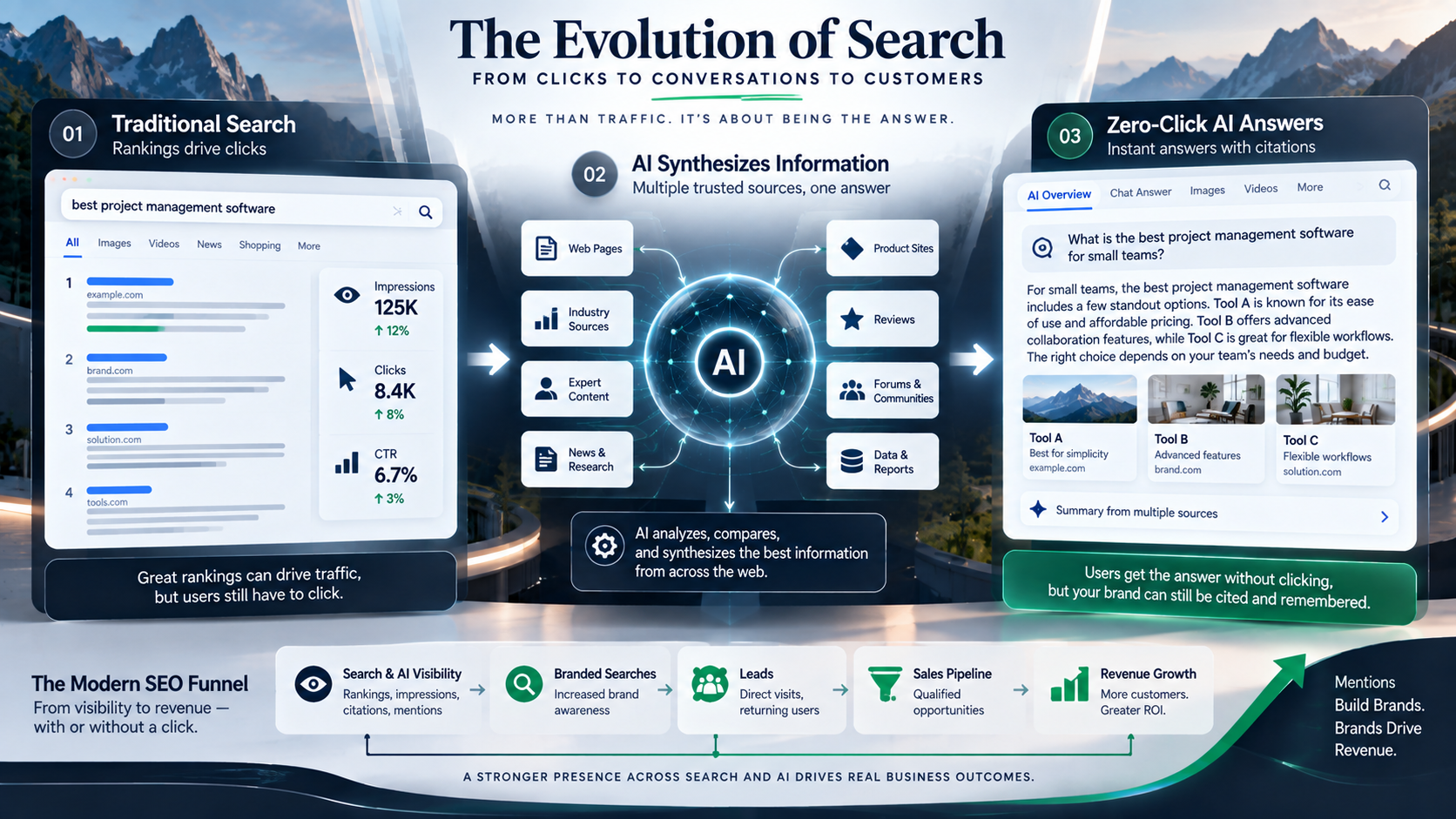
You might rank at the top but still get fewer visits if an AI-generated answer gives your customer what they need before they reach your site. The value of being seen is changing. It is not about traffic anymore. It is about being the brand that gets mentioned and remembered.
A B2B buyer may see an AI-generated comparison before clicking anything, while a consumer may ask an AI assistant to compare products instead of opening ten search results.
The solution is to create content that gives AI systems clear, easy-to-use evidence. This way, your brand becomes the trusted answer, not just another search result.
Track four outcomes:
- Traditional search visibility: impressions, rankings, clicks, and CTR.
- AI visibility: mentions, citations, and AI-generated answers.
- Brand demand: branded searches, direct visits, and returning users.
- Business value: leads, sales, pipeline, and assisted conversions.
The main change is simple: optimize your site so your brand's the source of answers AI systems rely on, rather than just the last place someone clicks.
Google AI Overviews vs. ChatGPT: What Changes?
Google AI Overviews and ChatGPT work differently, so your optimization strategy should cover both. If not, you could miss out on leads from either.
Google remains closely connected to web search. Search visibility depends on foundational SEO, crawlability, indexation, relevance, page quality, and content usefulness. AI Overviews can synthesize information from multiple sources and provide links for users who want to explore further.
ChatGPT can discuss the answer in a conversational way and can retrieve information from the web, depending on the product and question. It can also compile information from various sources instead of providing a standard ranking page.
That creates a useful distinction:
Use one content strategy for both: answer clearly, demonstrate expertise, and make evidence easy to understand.
The Five Pillars of AIO Optimization
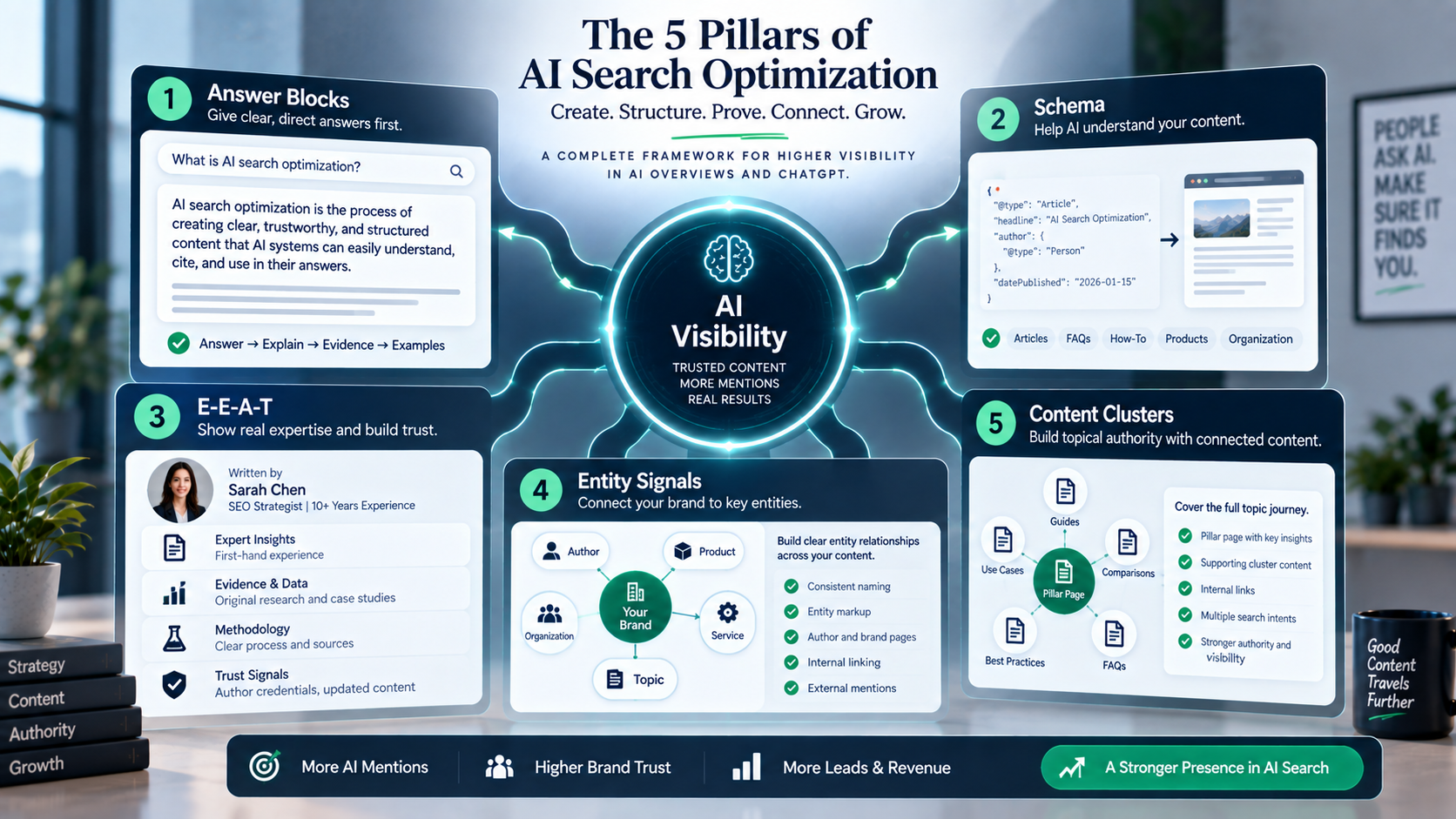
A strong AI-search strategy is built on five pillars that directly impact your visibility, leads, and revenue.
1. Answer Blocks
Place a short answer directly following a question-based heading. For many queries that are informational, a 40-60 word direct response is a good cut-off to begin with if you want to use Google to generate the answer extraction.
Use this formula:
Question → Direct Answer → Brief Explanation → Evidence → List, example, or table.
Avoid giving the answer at the end of a long introduction. When the user asks, "What is technical SEO?" explain it first, then give details.
For ChatGPT-oriented content, make important sections more self-contained. A roughly 134–180-word answer block can provide enough context for a conversational response without requiring information scattered across the page.
These numbers are guidelines, not rules. The most important thing is to be clear. Clear answers result in citations, increased trust, and sales.
2. Schema
Use structured data to show what your page is about, but don’t think schema is some magic AI shortcut.
Use supported markup that closely reflects the visible content. Depending on the page, you can use markup types such as Organization, Article, Product, SoftwareApplication, ProfessionalService, or FAQ.
Only add schema if it actually matches your content and helps your business goals. Chasing every new markup trend won't really move the needle unless it helps AI systems trust and cite your brand.
3. E-E-A-T
AI systems need facts they can trust. You must show that you are an expert.
Identify authors, explain qualifications where relevant, cite credible sources, show methodology, publish original research, and include firsthand experience. For commercial pages, explain why your company is qualified to make the recommendation.
Skip the boring claims like 'industry-leading solution.' Show real customer results, benchmarks, how you test, or your own data. That’s what builds trust with AI and your future customers.
4. Entity Signals
Make it super clear how your brand connects to your topics.
Use consistent company names, author information, products, services, locations, and industry terminology. Connect relevant entities naturally through internal links and authoritative references.
Your About page, author pages, organization information, profiles, press mentions, and consistent branding can help you build a more defined digital identity.
5. Content Clusters
Authorities for a whole commercial topic are not established on a single page.
Create topic clusters around a central theme, then discuss the questions, comparisons, implementation issues, scenarios, costs, alternatives, and results. Link these pages together so people and search engines can see how they all fit together.
The real goal? Build a bunch of actually useful info that makes your brand the go-to authority. That’s how you get more citations, leads, and sales—not just a giant pile of pages.
ChatGPT Optimization: Build for Answer-First Retrieval
Optimizing for ChatGPT? Make your info easy for AI to access and mention. Avoid keyword stuffing to improve the quality of mentions and keep your brand relevant when consumers are ready to buy.
Start important pages with a self-contained explanation of the topic. Then break complex subjects into clearly labeled sections. Use descriptive H2s and H3s, short paragraphs, tables, definitions, examples, and explicit comparisons.
Make factual claims easy to verify. Name the source, publication, organization, study, or methodology instead of making unsupported statements.
For high-value topics, create pages that answer the entire decision journey. For example, a SaaS company should not publish only “What is CRM software?” Build supporting pages covering implementation, integrations, pricing, alternatives, security, use cases, and comparisons.
This approach increases your brand's chances of being cited in AI answers and strengthens your authority on the topics that drive real business growth.
Always write for people first. Use a structure that machines can read to make things easier for your visitors—and to help AI surface your brand when it matters most.
Content Cluster Mapping: Build Share of Answer
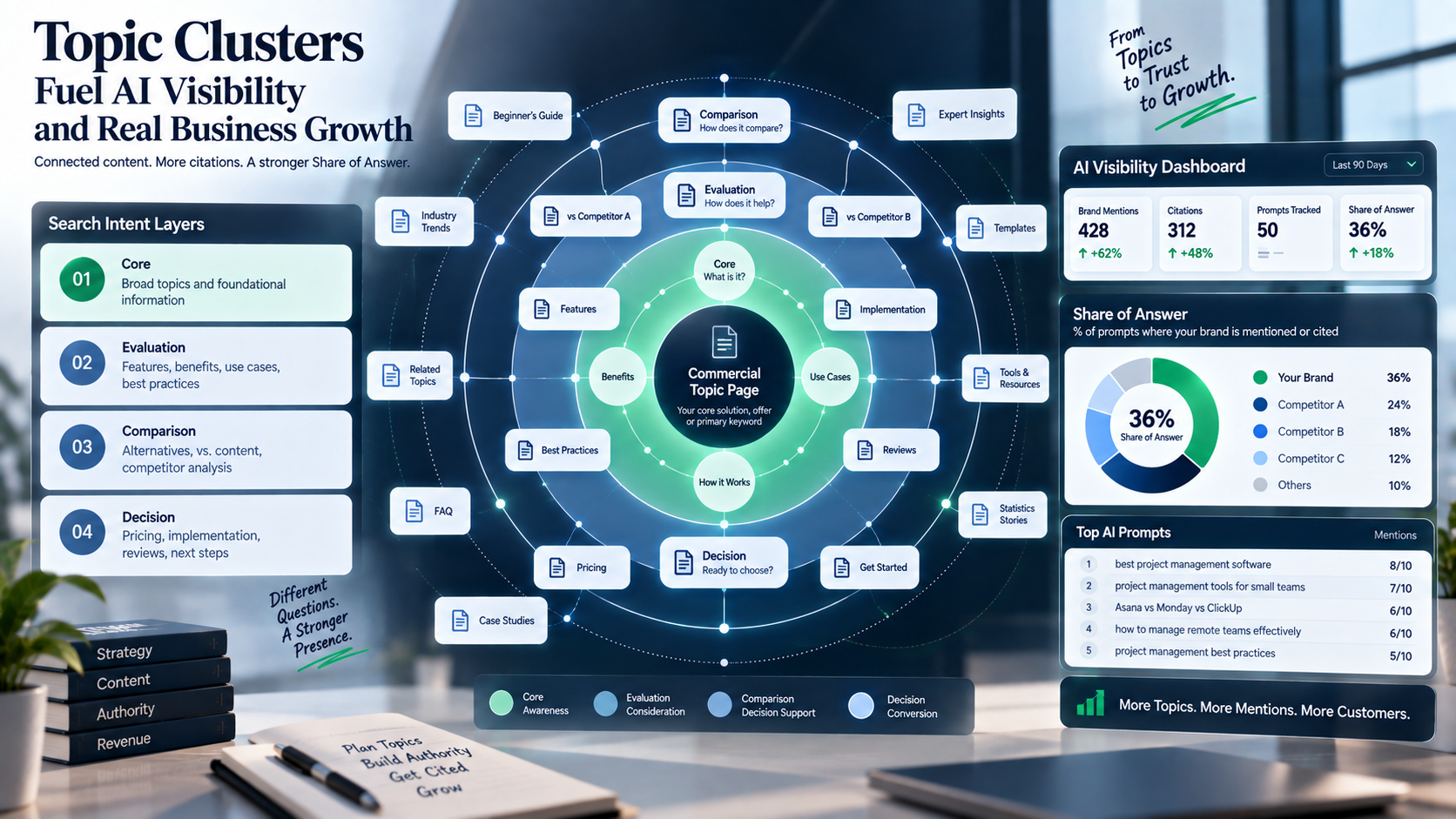
Traditional SEO asks the question, “How many keywords do we have ranking for?
There's one more question for AI search: “How frequently does our brand come up when customers ask questions about this topic?”
Call this Share of Answer: the percentage of tracked AI prompts where your brand, product, experts, or content is mentioned or cited compared with relevant competitors.
For each core topic, create a prompt map with four layers:
Core: What is the category or problem?
Evaluation: What tools, agencies, products, or approaches are the best?
Comparison: How does option A compare with option B?
Decision: What should a buyer choose for a specific use case, budget, industry, or constraint?
Then link one authoritative page to each main intent, and connect them with internal links.
Example:
Core: Webflow SEO
→ Webflow migration SEO
→ Webflow technical SEO
→ Webflow page speed
→ Webflow vs WordPress SEO
→ Webflow SEO agency
→ Webflow migration checklist
This framework allows AI systems to recognize your authority and expertise and supports real visitors on a journey that leads to higher conversions and sales.
Technical Checklist: Make AI Retrieval Possible
If search systems cannot easily read your content, you will miss AI citations and the leads that come from them.
Check these fundamentals:
- Important pages return successful status codes.
- Robots.txt does not accidentally block important resources.
- Valuable pages are indexable.
- Canonical tags point to the intended versions.
- XML sitemaps contain important canonical URLs.
- Internal links connect related pages.
- JavaScript does not hide essential content or links.
- Mobile pages contain the same important information.
- Structured data matches visible content.
- Page templates load quickly and provide a stable experience.
Double-check your AI crawler access settings. GPTBot and ChatGPT-User have different roles, so ensure your robots.txt file is optimized for both discovery and brand visibility.
For deeper implementation work, see 253 Media's guide to Technical SEO for AI crawlability.
Don't block AI crawlers by default. Review your robots.txt file and monitor your server logs to ensure you can access your best content. Otherwise, you may be losing out on citations or leads.
Tracking and Measurement: Build a Zero-Click Dashboard
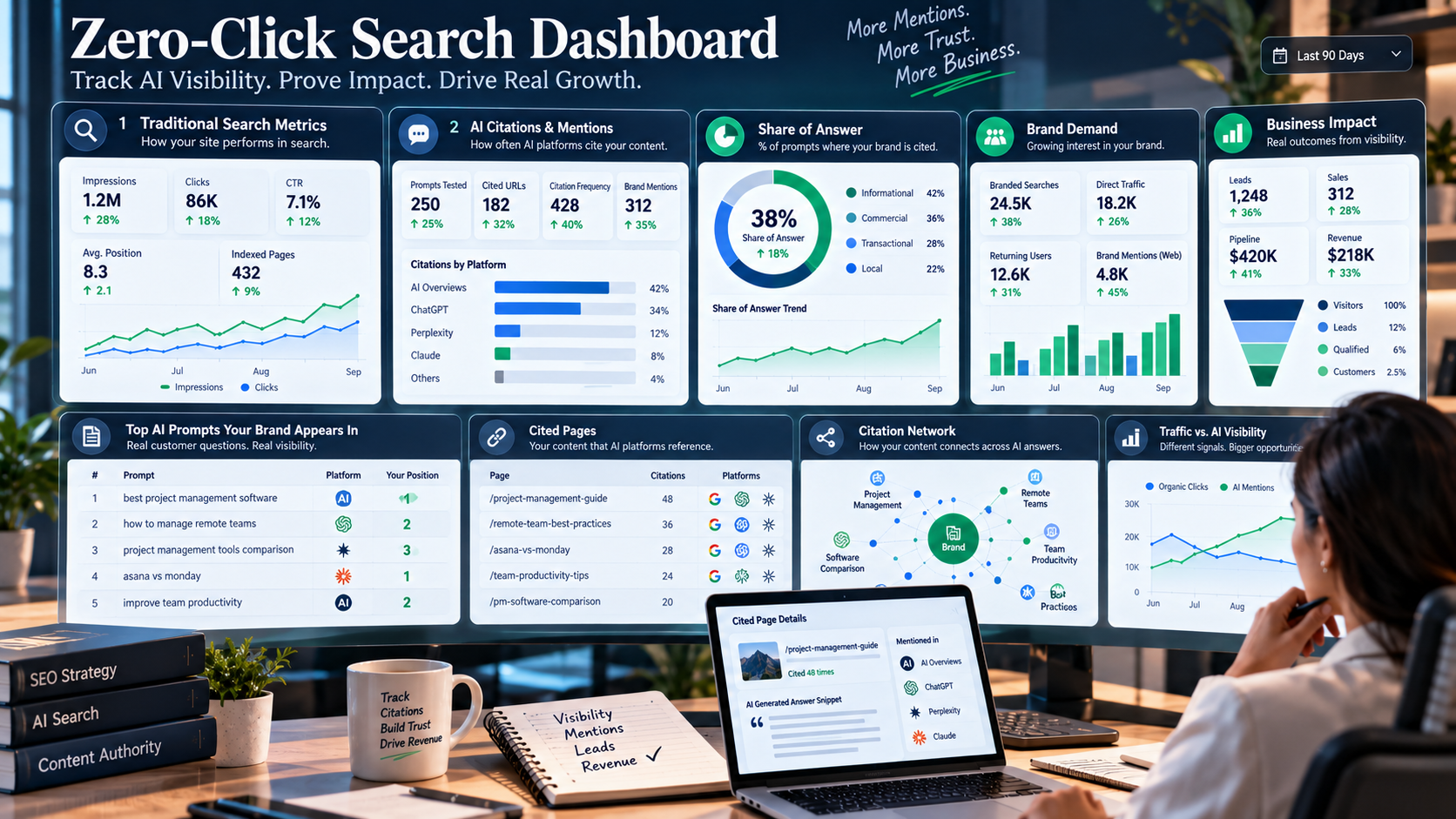
If you're only tracking organic traffic, you're missing the real impact of AI optimization. You need to measure citations, mentions, and the resulting business outcomes.
Create a dashboard with five sections.
Search: impressions, clicks, CTR, rankings, and indexed pages from Google Search Console.
AI citations: prompts tested, brand mentions, cited URLs, citation frequency, and competitor mentions.
Share of Answer: percentage of tracked prompts where your brand appears, ideally segmented by topic and intent.
Brand demand: branded impressions, branded clicks, direct traffic, returning users, and referral traffic.
Business impact: leads, sales, pipeline, revenue, and assisted conversions.
Test a fixed set of prompts consistently, and add new prompts as products, competitors, or customer questions change.
Record the exact answer. A citation for a low-value prompt is not equivalent to a recommendation for a high-intent buying query.
Examine visibility trends by brand, topic, funnel stage, geography, and competitors to identify opportunities to increase visibility and improve content.
Keep an eye on pages that are cited. When a research page continues to be cited, figure out what makes it stand out (originality, structure, evidence, or clarity) and use those same key ingredients in other high-value content to generate more leads.
How Long Does It Take to Rank in Google AI Overviews?
There is no guaranteed timeline. AI Overview visibility depends on the underlying search systems, query, competition, content quality, and whether your page is considered useful for the generated response.
Avoid waiting for a single ranking event. Establish a baseline and monitor your citation frequency, rankings, impressions, and branded demand over time. This way, you can identify which areas are really growing your business and put more effort into those areas.
Does ChatGPT Use Schema Markup?
There isn't a specific “ChatGPT schema” that guarantees pages will appear in search results, but schema helps search systems understand page entities and content.
Treat data as one part of a broader technical foundation. It is better to mark up content that is clear, reliable, easily accessible, and well-structured, with good entities and recognizable expertise, than to indiscriminately add markup.
What Is Share of Answer and How Do You Measure It?
Share of Answer measures how frequently your brand appears in a defined set of AI-generated answers to competitors.
Build a fixed list, run it consistently, record brand mentions and citations, identify competitors, and calculate your appearance percentage. Segment the results by topic, funnel stage, and commercial intent.
When it comes to conversions, Share of Answer is truly significant. It is not enough to be seen everywhere; you need a high share of those who really influence the purchase.
Mini Case Study: Three AI Overview Citations in 60 Days
Let's take a B2B SaaS brand that could be found in traditional search but was not frequently mentioned in AI-generated answers.
Instead of publishing more generic blog posts, the team rebuilt its highest-value topic cluster. It added concise answer blocks, original product data, expert commentary, clearer entity relationships, stronger internal links, and supporting comparison pages.
Over 60 days, the brand earned three AI Overview citations for priority queries while increasing visibility across related prompts.
The real takeaway is not about counting citations. The process is what matters: better organizing information, enabling easy review of knowledge, and monitoring citations for a set of key queries. That's how you can save and make more money.
When Should You Call an AIO Specialist?
If your rankings are in the same place but your organic traffic is declining, and your competitors are being featured in AI answers while you are not, you need an AIO specialist. When your team can't consistently measure citations, you're missing out on revenue.
When considering hiring one, ask:
- How will you separate traditional SEO performance from AI visibility?
- Which prompts will you track?
- How will you calculate Share of Answer?
- Will you audit technical crawlability and indexation?
- What will be the order of your content updates?
- What business outcomes will you report?
Be careful with anyone who claims they can guarantee a Google AI Overview appearance or a ChatGPT placement. AI-generated results change constantly, and no legitimate strategy can guarantee that an AI system will cite a specific brand or page.
A stronger approach is to focus on the factors you can control: your expertise, content structure, technical accessibility, supporting evidence, and measurable business outcomes.
For businesses that need help connecting technical SEO with AI visibility, 253 Media can be a useful starting point. Its services include SEO, Webflow, Shopify, and growth marketing, with strategy calls focused on understanding a brand's goals and building a growth plan.
Final Takeaway
Google AI Overviews and ChatGPT are transforming the way your customers search for information. However, your basic rules have not changed: provide valuable information, organize your site logically, ensure that your site is technically accessible, demonstrate actual skill, and treat your topics thoroughly. That will be the way to grow in 2026.
The difference is what you measure.
Avoid using clicks as your measure of strategy. Monitor citations, mentions, share of answer, brand demand, and conversions. This is what is actually important for your business.
Start at the top, where the most valuable topics are. Make answer-first pages that show off your knowledge. Provide genuine evidence to support claims and enhance entity signals. Link supporting material with relevant internal links. Keep your technical foundation accessible. Now try a series of consistent questions and double down on those that actually generate visibility, leads, and revenue.
If you need help identifying where your brand is losing AI visibility, 253 Media's AIO audit call provides a way to discuss your current website, goals, and growth opportunities.
In 2026, the goal isn't just to rank first. It's to become the source AI systems trust enough to cite—and the brand your customers remember when it's time to buy.