Shopify CRO Agency Playbook: 7 Ways to Improve Shopify Conversion Rate
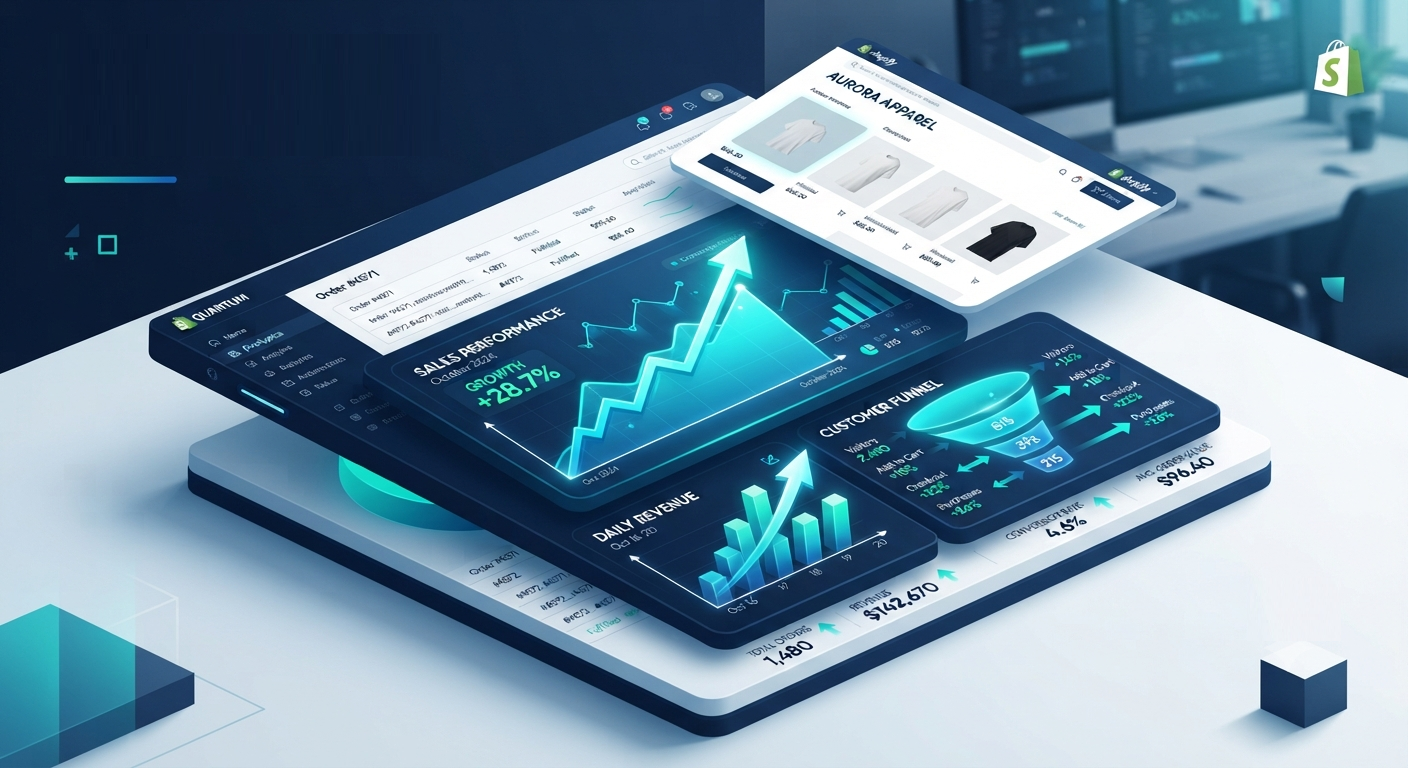
Driving more traffic to your Shopify store is just one part of the growth equation. When visitors don't act, can't find what they're looking for, abandon their carts, or leave at checkout, more visitors drive up ad costs without increasing sales.
A Shopify CRO agency helps you improve your conversion rate optimization. This ensures visitors who come to your site actually convert.
The goal is simple: turn more of the visitors you already have into paying customers.
This playbook explores 7 high-impact Shopify CRO opportunities, the issues behind them, the metrics to track, and practical test ideas to help you prioritize improvements.
Why Shopify CRO Matters More Than More Traffic
Let’s say your Shopify store gets 50,000 visitors/month. If you can increase this by 20%, it sounds great! However, if your product pages aren’t well written or your checkout process is complicated, you could be wasting money on extra traffic that isn’t converting.
CRO focuses on increasing the value that you obtain from your current traffic. Three metrics are particularly useful:
- Conversion rate (CVR): The percentage of visitors who purchase.
- Average order value (AOV): The average amount customers spend per order.
- Revenue per visitor (RPV): The revenue generated by each visitor.
By improving these metrics, you can grow your store without drastically increasing traffic.
For example, improving product discovery may increase conversion rate, while relevant bundles and upsells can increase AOV. Together, those improvements can increase revenue without requiring the same proportional increase in acquisition spend.
What a Shopify CRO Agency Actually Does
A good Shopify CRO agency should do much more than suggest changing your button and headline colours.
A strong CRO process combines analytics, customer behavior, UX, design, development, and experimentation to identify where potential customers are getting stuck.
The usual steps of the process are as follows:
- Analyze the funnel to identify drop-off points.
- Study customer behavior using analytics and behavioral data.
- Identify conversion barriers across landing, collection, product, cart, and checkout pages.
- Create testable hypotheses based on evidence.
- Prioritize opportunities according to impact and effort.
- Design and implement improvements.
- A/B test where appropriate.
- Measure business outcomes and continue iterating.
For Shopify brands, this can involve everything from product-page UX and landing pages to site speed, checkout friction, merchandising, SEO, and paid-traffic alignment.
The important distinction is that CRO should be a continuous improvement process, not a one-time redesign.
The 7 High-Impact Shopify Conversion Wins
1. Fix the First Five Seconds on High-Traffic Landing Pages
Visitors should be aware of three things right away:
What are you selling? Why should they care? What should they do next?
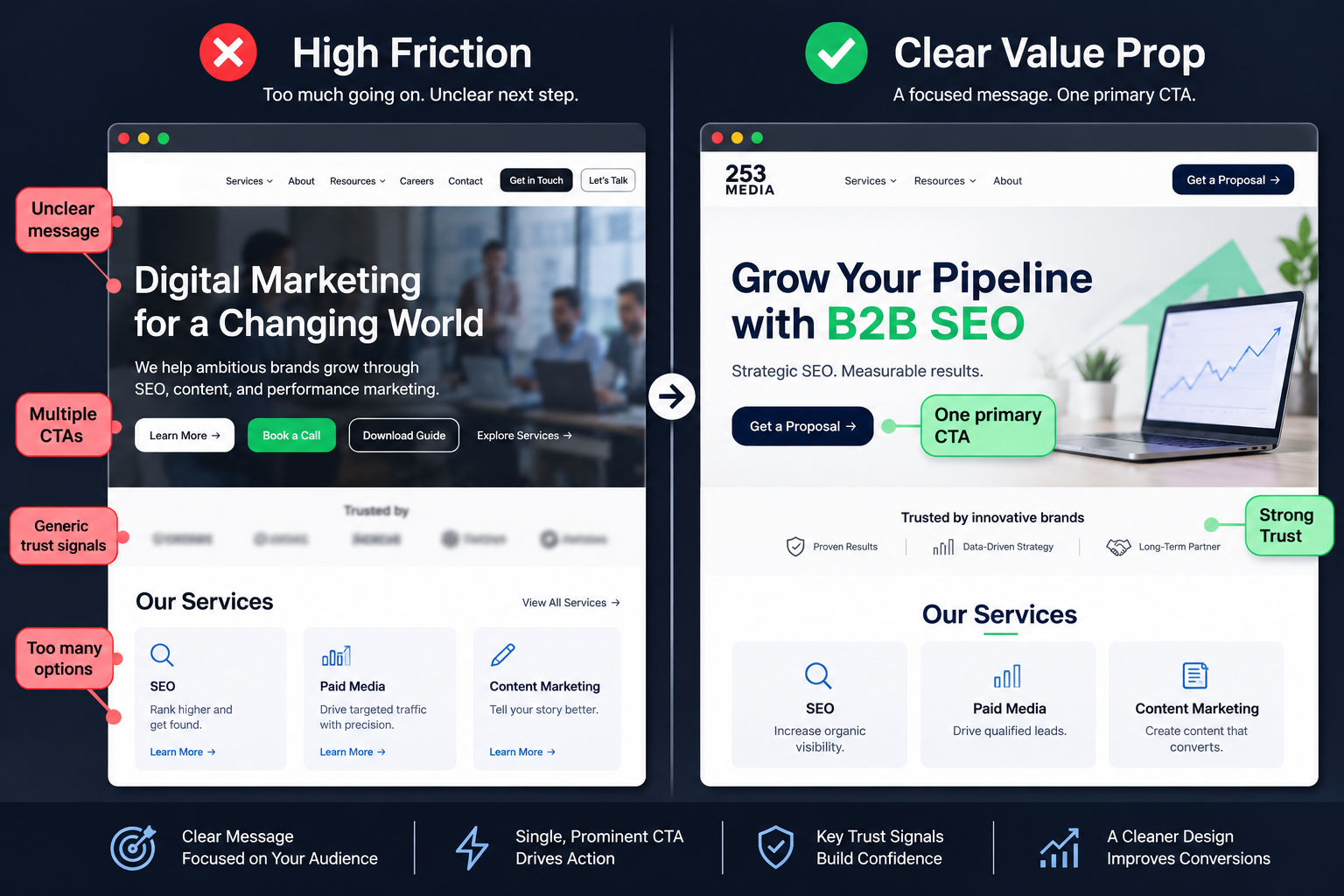
If your hero section is unclear, with multiple CTAs and poor imagery, customers may leave your page immediately.
The fix
Make the first screen on important landing pages immediately useful. Consider:
- A clear value proposition
- Product-focused imagery
- A compelling primary CTA
- Relevant social proof
- A concise explanation of the offer
- Visitors arrive through an ad or search query, and the messaging should align with it
The experience should feel like a continuation of the customer’s intent, not a reset.
KPI to watch: Landing-page engagement, bounce/exit behavior, conversion rate, and revenue per visitor.
Test idea: Compare your current hero section with a new one that has a clear value proposition, better product benefits and only one main CTA.
This is usually a high priority for brands that are receiving high volumes of paid traffic. Even small changes can impact the value of each session.
2. Rebuild Product Pages Around Buyer Objections
Your product pages should give customers enough confidence to complete a purchase.
If customers can't quickly find answers about sizing, materials, quality, shipping, returns, compatibility, or how the product performs, even a great-looking product page won't help much.
The fix
Create product pages based on customer queries prior to purchase.
Depending on the product, that may include:
- High-quality product photography
- Video or demonstrations
- Reviews and ratings
- Size or fit information
- Product specifications
- Shipping expectations
- Return information
- Guarantees
- Trust signals
- FAQs
- Clear product benefits
- Strong mobile UX
Keep important buying information just a few clicks away. Don't hide it several clicks deep.
KPI to watch: Product-page-to-cart rate, conversion rate, AOV, and revenue per visitor
Test idea: Create a new version of your product page and place your reviews, key benefits, delivery info and trust elements near your main purchase area.
The right change depends on your customer data. The CRO audit must determine which objections are likely to be causing friction before suggesting a redesign.
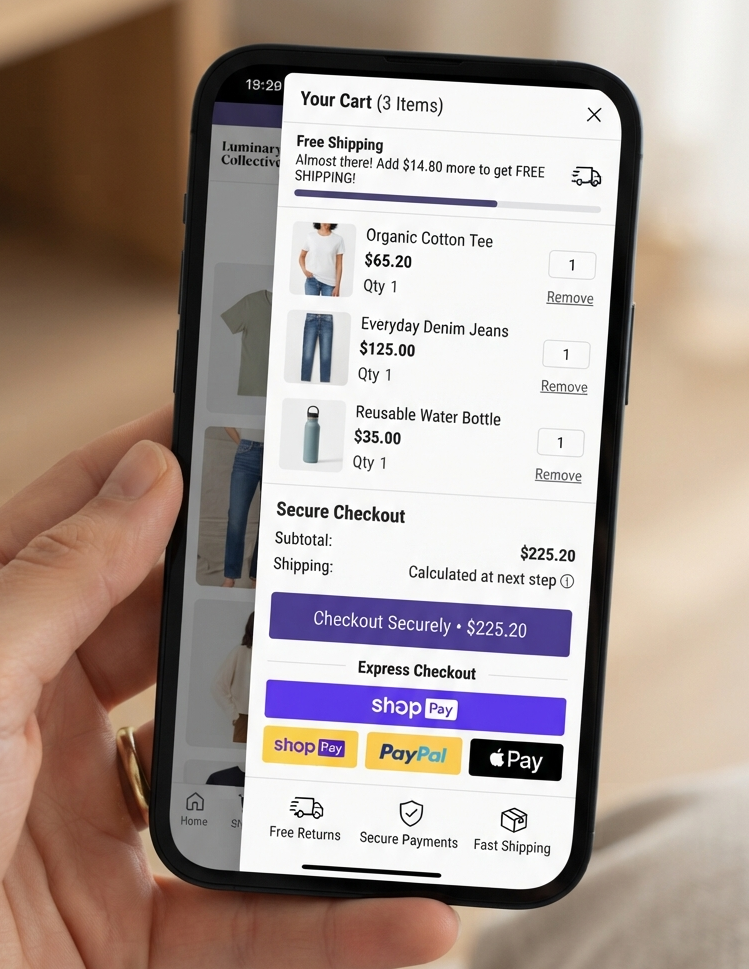
3. Reduce Friction From Cart to Checkout
When someone adds an item to their online shopping cart, they've already shown some interest in purchasing it. When the next step is unclear or unexpected, and the customer gets lost, it costs you.
Common friction points include unclear shipping costs, unexpected fees, limited payment options, confusing navigation, or unnecessary distractions.
The fix
Walk through the entire experience from cart to checkout.
Make sure customers can easily understand it.
- What they are buying
- The total cost
- Shipping expectations
- Available payment methods
- Return or refund policies
- Any relevant discounts
- What happens next
Also ensure your checkout is mobile-friendly. With less screen space, issues can become more obvious.
KPI to watch: Cart-to-checkout rate, checkout completion rate, and purchase conversion rate.
Test idea: compare the current cart with a simplified version that more clearly highlights total cost, shipping expectations, and the primary checkout CTA.
4. Use Urgency, Bundles and Upsells Without Damaging Trust
Increasing conversion rate is not the only CRO opportunity. You can also improve the value of each order.
By adding relevant bundles, recommendations and upsells, you can improve your AOV. These can help customers make better purchase decisions.
The key word is relevant.
Adding fake countdown timers, fake urgency and pushy pop-ups can cause people to lose trust in your brand.
The fix
Test credible merchandising strategies such as:
- Frequently bought together products.
- Product bundles
- Quantity discounts
- Complementary accessories
- Free-shipping thresholds
- Relevant post-purchase offers
KPI to watch: AOV, revenue per visitor, attachment rate, and overall conversion rate.
Test idea: Compare a standard product page with a relevant bundle or complementary-product recommendation.
A good upsell should increase the order value without really hurting the conversion rate
5. Improve Collection-Page Discovery and Product Sorting
Not everyone will know exactly what they want to buy.
Therefore, having a good collection page is key to helping your visitors find the right products. Too many irrelevant products to scroll through, or making it difficult for customers to filter a large product range, can cause them to leave.
The fix
Improve product discovery with:
- Useful filters
- Clear category structure
- Relevant sorting options
- Product badges where appropriate
- Helpful collection descriptions
- Strong product imagery
- Consistent product cards
- Mobile-friendly filtering
Think about how customers make decisions, not just how your inventory is organized.
KPI to watch: Collection-to-product-page clicks, product discovery rate, conversion rate and revenue per visitor.
Test idea: Try a new collection layout, better filtering, sorting and product-card info.
It's not about giving the consumers more options. It's for their benefit to get them to a correct decision sooner.
6. Improve Site Speed and the Mobile Experience
A slow store drives customers away before they even see what you have to offer.
This is particularly the case for Shopify brands relying on mobile and paid traffic. When people click an ad, they will expect your landing page to load quickly and be easy to use on mobile.
Review:
- Page-load performance
- Core Web Vitals
- Image sizes
- App impact
- Mobile navigation
- Tap targets
- Sticky elements
- Product-page usability
- Cart and checkout behavior
Don't think of speed as a technical metric that's separate from CRO. Performance affects the shopping experience.
KPI to watch: Engagement, mobile conversion rate, page performance and revenue per visitor.
Test idea: Compare performance and conversion behavior before and after reducing unnecessary scripts, optimizing media, or simplifying mobile components.
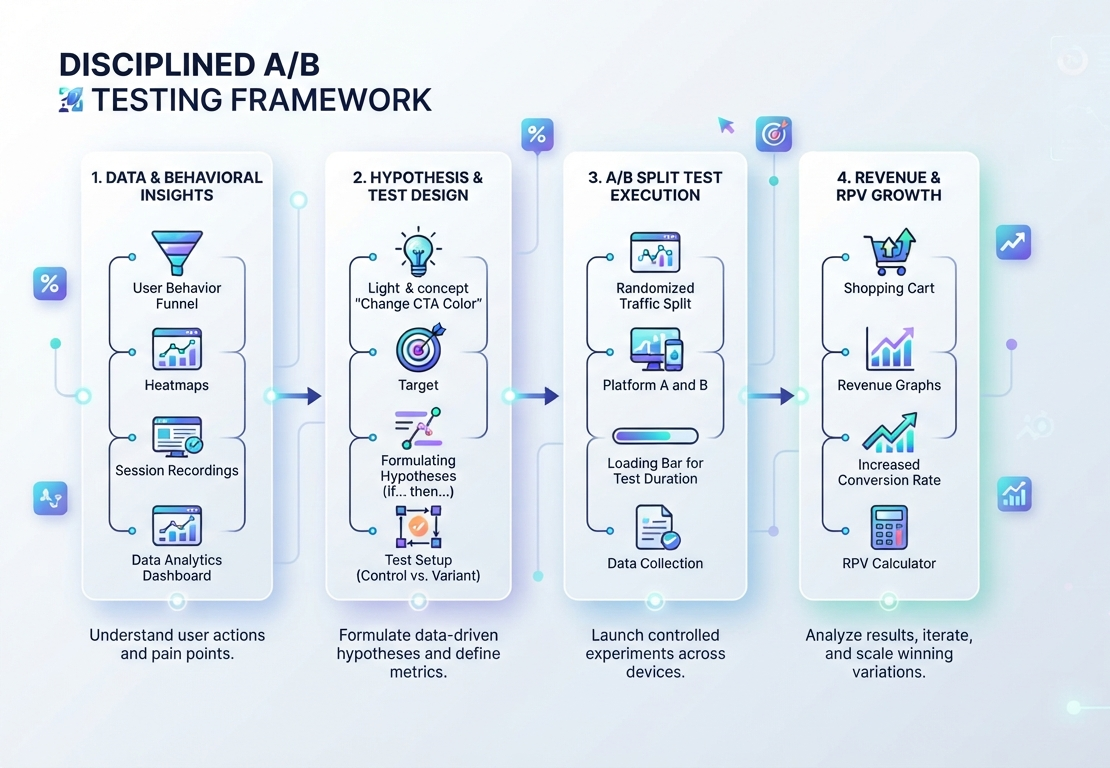
7. Build a Disciplined Shopify A/B Testing Program
Random changes aren’t a CRO strategy.
Changing a headline today, redesigning a product page next week, and adding a pop-up the week after makes it difficult to know what actually improved performance.
Creating a structured Shopify A/B testing strategy will help your team learn more.
Start with a hypothesis:
If we make X change, we expect Y customer behavior to improve because of Z evidence.
Then define:
- The primary KPI
- The test audience
- The test duration
- The expected outcome
- Secondary metrics to monitor
- The decision criteria
Whilst conversion rate is important, don’t forget to look at other metrics. If your test improves conversion but causes smaller orders, you may not achieve the business goal you were aiming for. If applicable, measure conversion rate (CVR), average order value (AOV), revenue per visitor (RPV) and total revenue together.
For a deeper testing framework, explore our Shopify A/B testing guide.
How to Prioritize CRO Opportunities
During a CRO audit, you can find multiple areas to improve. To decide where to start, it can be helpful to look at:
This prevents teams from spending weeks on low-impact cosmetic changes while ignoring major checkout or product-page problems.
A Shopify CRO agency should provide a prioritized roadmap that ranks each opportunity by impact, evidence and effort.
DIY CRO vs. Shopify CRO Agency
For teams that have the right resources and expertise, DIY CRO can make sense.
When your team requires an expert with a fresh perspective on conversion issues, a Shopify CRO agency is more valuable.
How 253 Media Approaches Shopify CRO
253 Media approaches Shopify CRO as a profit-first growth discipline, combining strategy with the ability actually to implement the work.
To improve conversions, we need a comprehensive strategy that combines Conversion Rate Optimization (CRO) with Shopify design and development, A/B testing, landing page optimization, SEO, paid media, and analytics. This all-encompassing approach acknowledges that conversion issues are often interconnected, not isolated user experience problems.
A product page may have a UX problem. But the underlying issue could be a mismatch between the ad promise and landing-page messaging, weak product positioning, poor mobile performance, or a lack of trust signals.
The right solution starts with finding the actual barrier.
If you’re evaluating Shopify CRO agency services, 253 Media can help identify conversion opportunities and turn them into an actionable roadmap.
How Can a Shopify Store Get More Revenue From Existing Traffic?
Your next growth opportunity may be hiding within your current traffic.
By implementing the right CRO process, you can identify friction, prioritise high-value opportunities, and improve your Shopify store. You should always be focusing on improving your business outcomes.
Schedule a Shopify CRO strategy call to find out where your store is losing revenue, which opportunities are worth pursuing, and how to boost your conversion rate, AOV, and revenue per visitor.
More traffic is valuable. More value from every visitor is better.