
How a B2B SaaS SEO Agency Builds Pipeline: Strategy, Timelines, and ROI
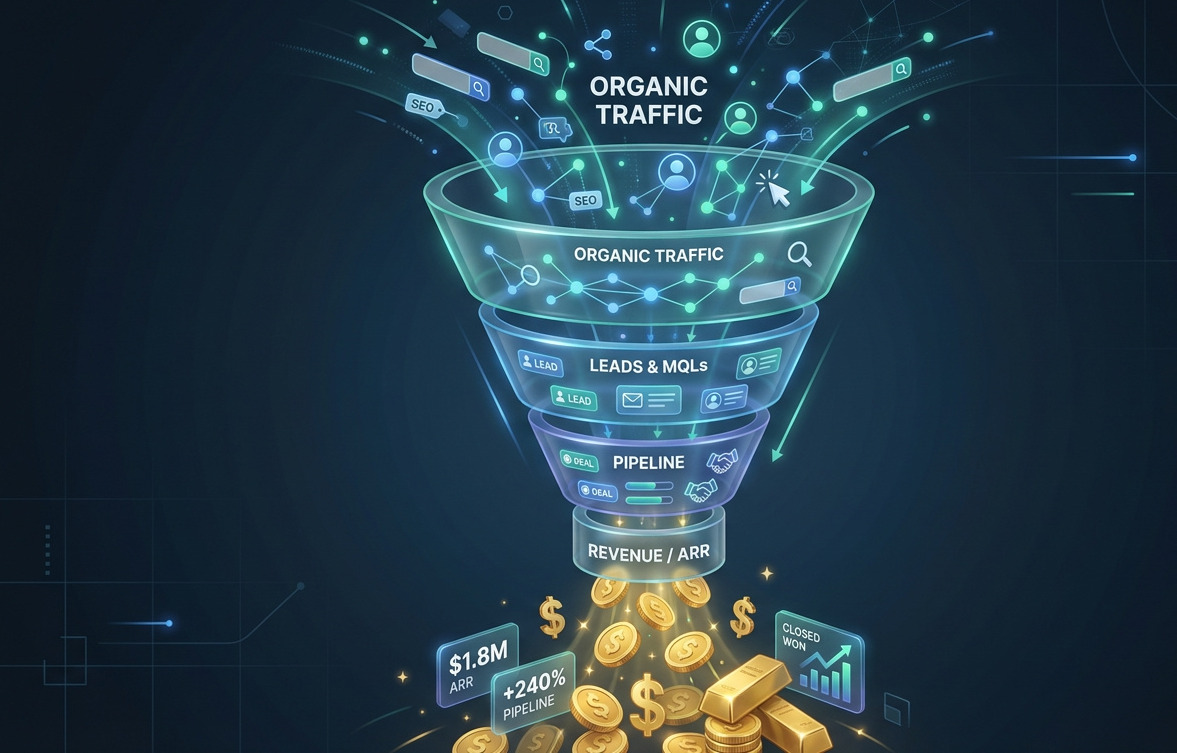
SEO should bring more than clicks for B2B SaaS businesses. The actual challenge is if organic search generates qualified leads, demos, SQLs, opportunities, and revenue.
A good B2B SaaS SEO agency ensures the search strategy aligns with the entire sales funnel, from the initial search for a problem to product comparison and the final sales call. Let's take a look at what that process is like, what happens in the first 90 days, and how to determine whether SEO is working.
What Is a B2B SaaS SEO Agency?
A B2B SaaS SEO agency develops a software company’s organic search so that it can be used to drive measurable sales.
Instead of producing blog posts around high-volume keywords alone, the agency maps search demand to the SaaS buying journey. That can include:
- Category and solution pages
- Product and feature pages
- Use-case pages
- Comparison and alternative pages
- Integration pages
- Problem-aware content
- Bottom-funnel commercial queries
- Content that supports AI-assisted search
It's not just about ranking! It's about drawing in the right prospects at the right time in the buying cycle and providing a compelling course of action, such as a demo, trial, consultation, etc.
Why SEO Matters for B2B SaaS Pipeline
Typically, B2B SaaS buyers don't decide to buy after a single website visit. A prospect can research a problem, review vendors, read reviews, explore integration options, discuss with others, and visit multiple times before reaching out to sales.
Across these sessions, SEO can play an important role.
Awareness content highlights problems and builds familiarity. Comparison and category pages attract prospects actively assessing solutions. Product, feature, and integration pages address specific buying questions. Conversion assets then turn that research into a demo request, trial, or sales conversation.
This is especially important for B2B SaaS businesses that want to decrease reliance on paid sales and develop a sales-boosting organic sales arm.
The Pipeline-First SEO Strategy
A transparent SaaS SEO strategy should follow a clear sequence.
1. Map the ICP to Revenue
Start with the ideal customer profile, not a keyword list.
Find out target companies, roles of buyers, pain points, use cases, deal criteria, objections, and language used in sales conversations during sales conversations.
This makes it possible to see which search opportunities are commercially valuable.
2. Map Keywords to the Buying Funnel
Every important query should have a reason to exist.
Assign map keywords to awareness, consideration, decision and retention stages. What is can be used to build awareness, and what is the best software or what is the alternative to [competitor] can show significantly higher buying intent.
3. Build the Technical Foundation
Optimising your online presence is critical to helping both search engines and people easily find your content.
This includes:
- Crawlability and indexation
- Site architecture
- Internal linking
- Core Web Vitals and page experience
- Metadata
- Schema
- Duplicate or thin pages
- Mobile usability
Technical SEO isn't the whole strategy; it's the foundation for all the other strategies.
4. Build Commercial Content Architecture
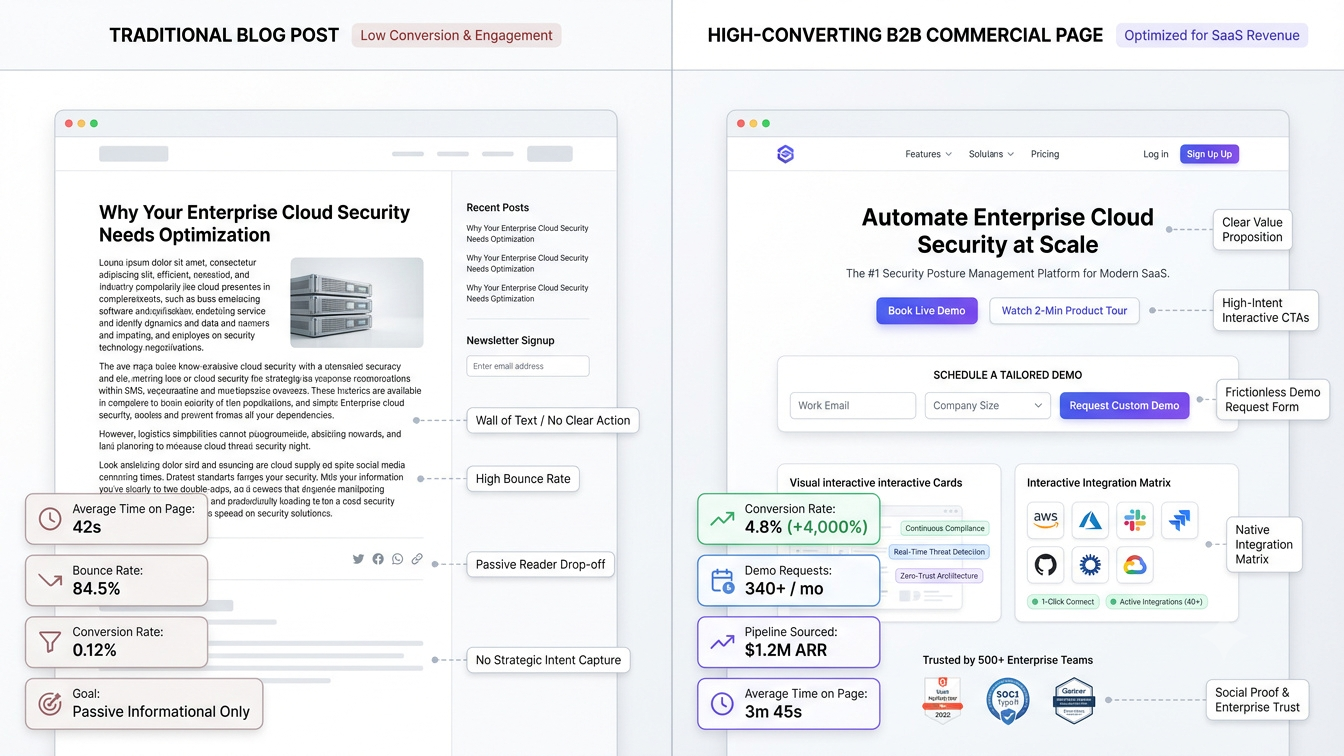
B2B SaaS SEO is not just about educational blogs.
Create topic clusters based on categories, use cases, integrations, alternatives, comparisons, features, and buyer objections. This creates multiple touchpoints for prospects at various stages.
5. Connect Content to Conversion Paths
If visitors don't have any relevant place to go, organic traffic won't help much.
Link pages to demos, free trials, ROI calculators, webinars, newsletters, sales materials, and any other relevant conversion action.
For Webflow businesses, this can also involve integrating Webflow SEO services with design and development that convert.
6. Build Authority
Competing in SaaS search results often demands more than optimizing on-page elements.
Building your site's authority with relevant backlinks, digital PR, expert content, partnerships, and good original content can help you dominate the competition for important keywords.
7. Connect SEO to Pipeline
Finally, connecting organic activity to CRM and revenue data is key.
The reporting chain needs to shift from:
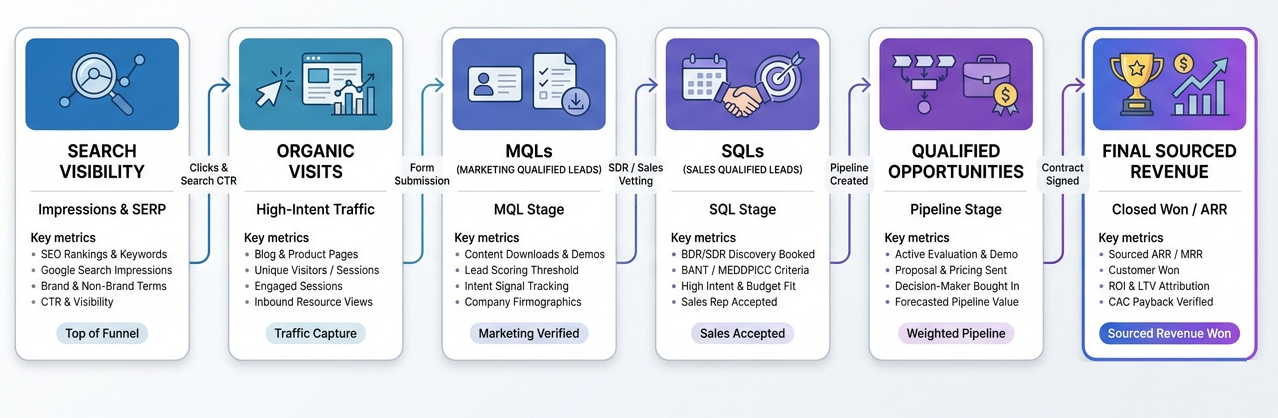
Search visibility → organic visits → conversions → MQLs → SQLs → opportunities → pipeline → revenue
That is the difference between traffic reporting and pipeline reporting.
The First 90 Days With a B2B SaaS SEO Agency
The first three months should be used to set the stage and provide opportunities for early improvement.
The speed of the process varies with the site's authority and technical quality, market, competition, content quality, and demand.
What Results Should You Expect—and When?
Unlike paid media, SEO does not work the same way.
Improving and optimizing existing pages can lead to faster progress. New content, authority-building initiatives, and competitive commercial pages usually take longer to gain visibility and drive significant conversion volume.
SEO turns into a channel that compounds over time rather than delivering immediate performance.
Any agency that guarantees rankings, leads, or revenue within a certain time should be considered not credible. Instead, it should outline what it will do, which performance metrics it will analyse, and how the strategy will adapt based on data.
The Metrics That Prove SaaS SEO ROI
A strong reporting system moves from leading indicators to business outcomes.
Leading indicators
- Impressions
- Organic clicks
- CTR
- Rankings
- Indexed pages
- Referring domains
- Engagement
Conversion indicators
- Organic leads
- Demo bookings
- Trial sign-ups
- Form completions
- MQLs
- SQLs
Revenue indicators
- Pipeline created
- Pipeline influenced
- Opportunities
- Win rate
- Organic-sourced ARR
- CAC payback
- SEO ROI
AI-search indicators
- AI citations
- Share of Model
- Branded search growth
- Visibility during AI-assisted research
Don't think of AI search as a standalone alternative to SEO. The same principles that help with visibility in evolving search experiences—delivering useful content, good information architecture, authority, clear expertise, and relevant pages—also apply here.
How to Calculate B2B SaaS SEO ROI
A basic formula for revenue is:
SEO ROI = (Organic-sourced revenue − SEO investment) ÷ SEO investment × 100
For pipeline-focused reporting, use:
Pipeline ROI = Qualified pipeline influenced by organic search ÷ SEO investment
For example:
This model is illustrative and not an assurance of performance. Actual results will vary depending on search demand, product category, sales cycle, average contract value, competition, conversion rates, and attribution.
Add assisted conversions to attribution for B2B SaaS companies. A prospect may find a company through SEO, then come in through branded search, read the sales content, and convert after the sales interaction – these could be missed by last-click reporting.
What a Strong B2B SaaS SEO Agency Should Deliver
If you're searching for an agency, these are the things that you should consider:
- Before content creation- Define your Ideal Customer Profile (ICP) and revenue goals.
- Keyword Strategy- Match keywords to various points of the buying cycle.
- Technical Optimization- Maintain strong technical performance and page experience.
- Content Focus- Prioritize commercial pages over just blog posts.
- Conversion Alignment- Create content that aligns with your conversion paths.
- Tracking and Reporting: CRM and Attribution models for pipeline and revenue reporting.
- Clear Plan- Establish a clear 90-day roadmap.
- Continuous Improvement- Emphasize continuous testing and iteration.
- Search Strategies- Develop strategies for both traditional and AI-assisted search.
The ideal agency relationship should be more of an acquisition channel than a fixed number of articles.
Common B2B SaaS SEO Mistakes
There are several ways to generate activity without creating pipeline.
Publishing generic thought leadership: Traffic from broad topics may have little connection to your ICP.
Ignoring commercial pages: Many SaaS businesses write numerous blog posts but fail to further develop niche, comparison, interoperability, and application areas.
Targeting keywords without business context: Search volume does not automatically equal buying intent.
Ignoring technical SEO: Even excellent content struggles if crawl issues, indexing problems, site architecture flaws or poor page experience exist.
Disconnecting content from conversion: Every high-value page should have a logical next step.
Relying only on last-click attribution: B2B sales cycles are long and involve many touchpoints—both from organic and non-organic sources.
Treating AI search as completely separate: AI visibility should go hand in hand with your overall search strategy, not replace it.
How 253 Media Approaches B2B SaaS SEO
253 Media takes a performance-focused approach to SEO by connecting search visibility with content, conversion-focused web experiences, paid media, and analytics.
The goal is not just to rank pages. It’s to build a system that drives organic growth.
For SaaS companies, this could be SaaS Webflow SEO, Webflow design & development, technical Webflow SEO, commercial content, lead flow paths, and measurement.
The strategy always comes back to one question:
Are organic search opportunities providing better quality leads for the company?
Book a B2B SaaS SEO Strategy Call
If your SaaS company is ready to make SEO accountable to pipeline, start with a strategy conversation.
During the B2B SaaS SEO strategy call, we can review your ICP and current organic search performance, and highlight areas for improvement in your technical SEO. We can also identify search terms that have lead-generation potential, key content themes, conversion options, and your chosen attribution model.
Book a call with 253 Media to discuss your B2B SaaS SEO strategy.
The best approach to SEO is to view rankings as a tool, not the goal. Create visibility that influences buyers and track the resulting pipeline.