How to Recover Organic Traffic When Google AI Overviews and SGE Reduce CTR
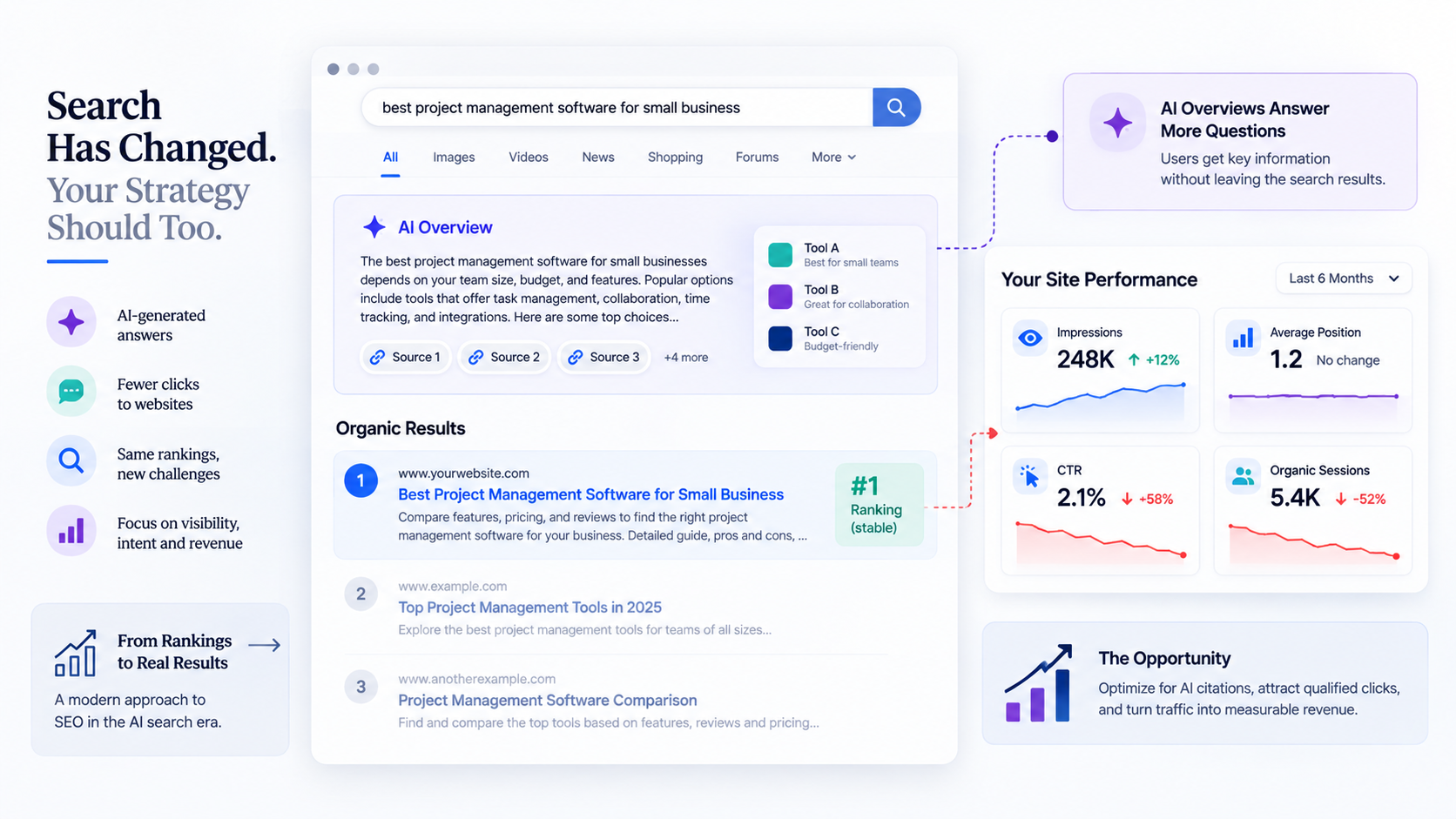
Your rankings look stable. Your impressions may even be increasing. Yet organic sessions, leads, and revenue from search are going down.
If that sounds familiar, your SEO strategy may not have suddenly stopped working. The search results themselves have changed.
Google AI Overviews and AI-powered search experiences are taking up more space above traditional organic listings, answering some queries before users ever visit a website. This means SEO must evolve beyond just rankings and sessions. The new focus should be on AI citations, qualified clicks, conversion intent, brand visibility, and post-click value.
Here’s a step-by-step framework you can use to recover your organic performance in today’s AI-driven search landscape.
Why Your Organic Traffic Can Drop Even When Rankings Look Fine
Traditional SEO often works with a relatively simple equation:
Higher rankings → higher visibility → more clicks → more traffic.
AI search changes that equation.
A searcher can now enter a question such as:
“What is the best ecommerce platform for a growing fashion brand?”
Google may provide an AI-generated summary comparing platforms before the user reaches the traditional results.
Users can now get enough information to decide without ever clicking through to your site.
This is especially true for informational searches. Your page might still rank #1, but if Google answers the question in the results, you’ll see fewer clicks.
Google itself says AI Overviews and AI Mode are designed to help people understand complicated topics and explore supporting links. Google also states that the fundamental SEO requirements remain the same: pages need to be crawlable, indexable, eligible for snippets, and genuinely helpful.
So your next goal is to make your content the obvious choice for AI citations, drive qualified clicks, and turn those visits into leads or sales.
That is the foundation of modern Answer Engine Optimization (AEO).
What the 2025–2026 Data Actually Shows About AI Overviews and CTR
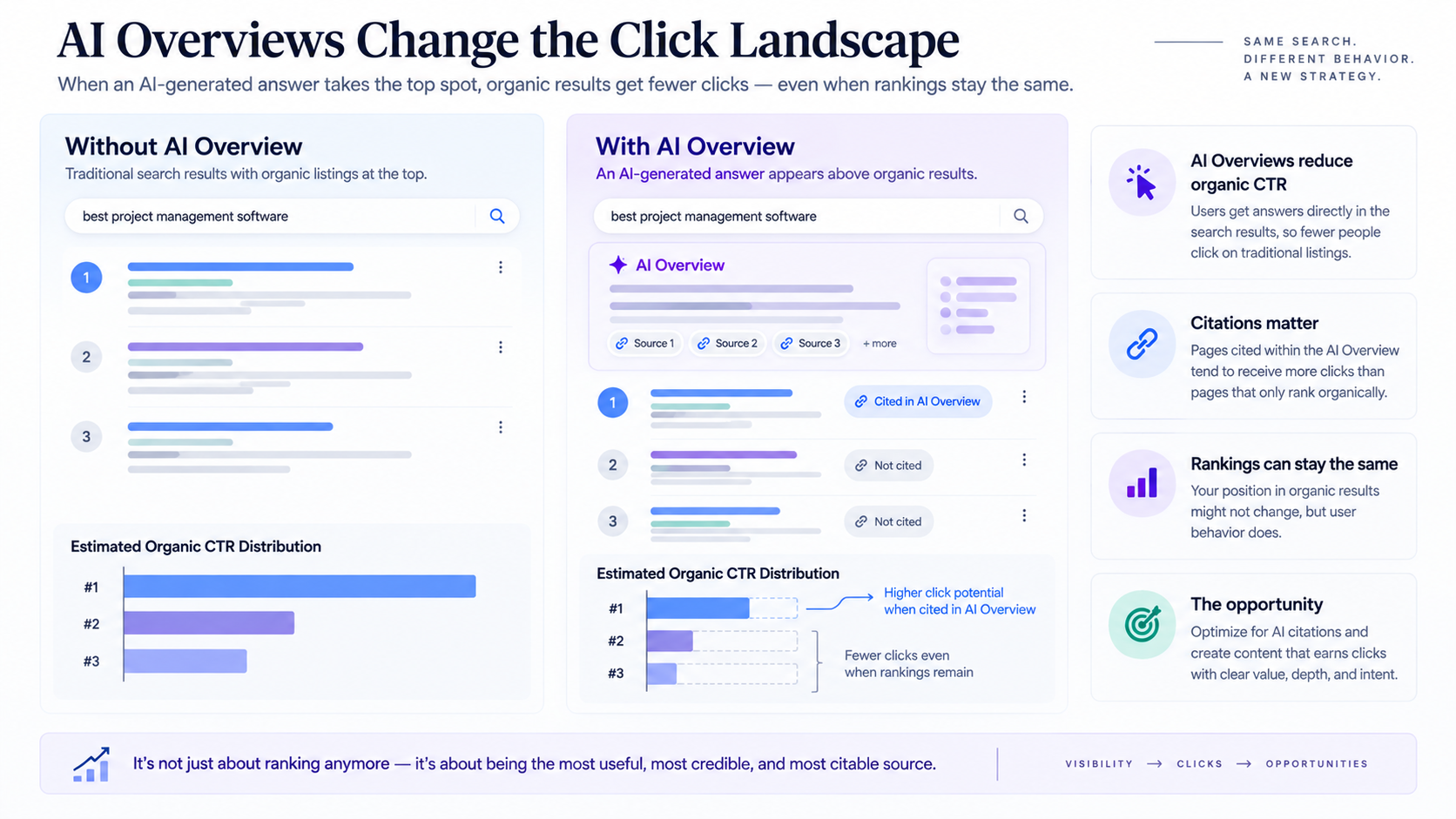
The decline in organic CTR isn't theoretical.
Ahrefs analyzed 300,000 keywords using December 2025. They found that the presence of an AI Overview was associated with approximately a 58% reduction in CTR for the #1 organic result compared with its estimated CTR without an AI Overview. The impact extended beyond position one, significantly reducing click-through rates for positions two and three.
Seer's larger 2026 study, which included 5.47 million tracked queries, 2.43 billion organic impressions, and 53 brands across informational, transactional, and commercial intent, found an important nuance. Organic CTR for AIO-affected queries reached a low point in December 2025 but improved during early 2026.
More importantly, Seer found that citation status matters. Pages cited within AI Overviews generated significantly higher organic CTR than pages that ranked but weren't cited.
This shifts your strategy.
You don't want to choose between:
- Ranking in traditional search
- Appearing in AI Overviews
You need pages that rank well and earn AI citations.
Which Searches are most Vulnerable?
Pure informational queries are most at risk, since AI-generated answers can satisfy the user’s need without a click.
For example:
- “What is technical SEO?”
- “How does Shopify SEO work?”
- “What is AEO?”
- “How long does SEO take?”
A user may not need to click immediately.
Commercial and action-oriented searches can be different.
Queries such as:
- “Shopify SEO agency”
- “Shopify Plus migration agency”
- “best Shopify agency for fashion brands”
- “Shopify SEO audit”
- “Webflow SEO consultant”
Often require deeper evaluation.
This shift is also an opportunity. Even if you get fewer clicks, you can make each one count by focusing on leads and revenue.
Is AI Overviews Really Causing Your Traffic Drop?
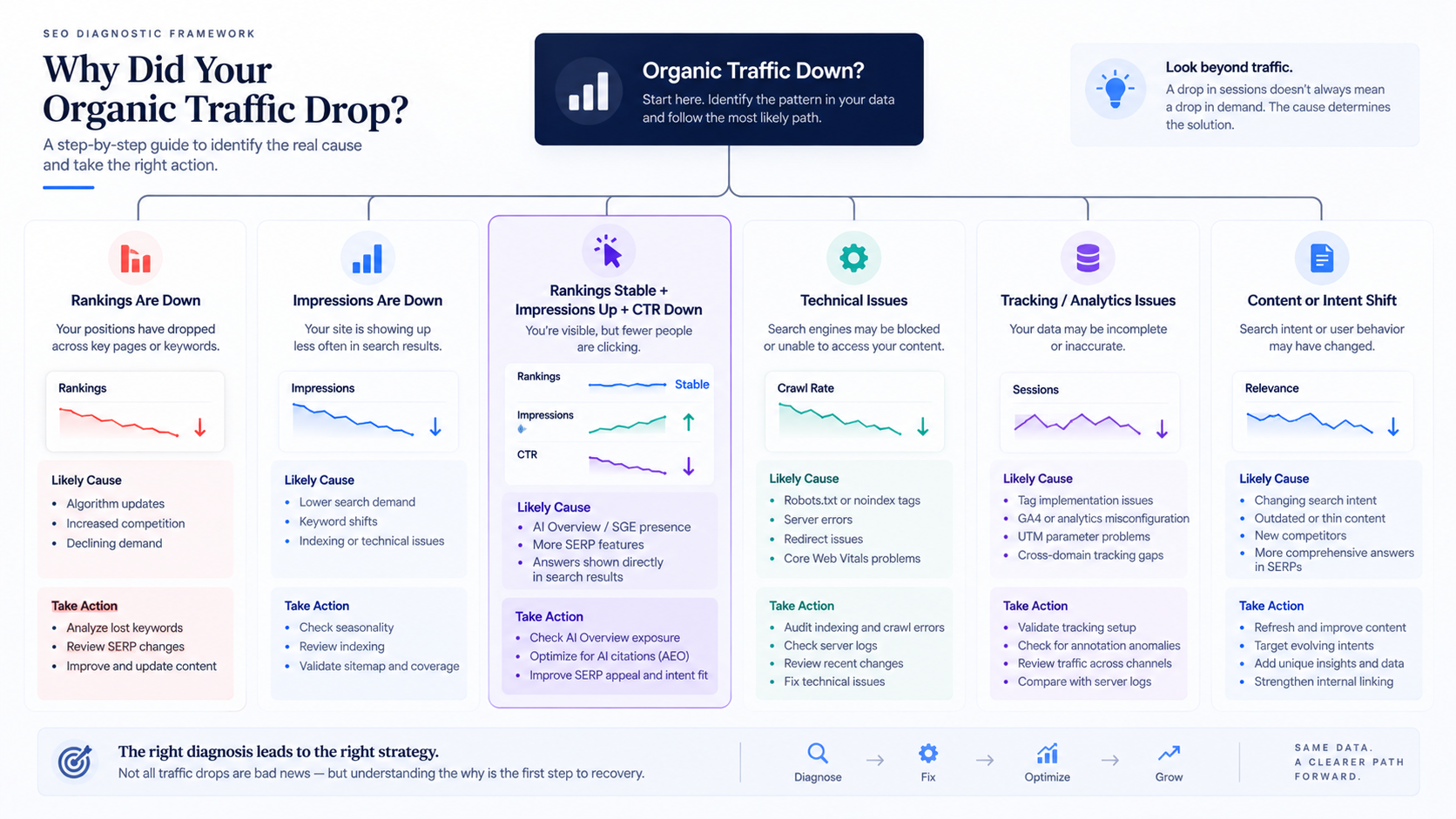
Before you start rewriting content, diagnose what’s actually causing the drop.
A traffic decline can come from several causes:
The key signal to investigate is:
Stable rankings + increasing impressions + falling CTR.
That combination can indicate that search results are capturing more of the user's attention before the traditional organic listing gets clicked.
Step-by-Step: Diagnose AI Overview Cannibalization in Google Search Console
Start with at least 12 months of Google Search Console data to distinguish a recent SERP change from normal seasonality.
Step 1: Export your performance data
Focus on:
- Queries
- Pages
- Clicks
- Impressions
- CTR
- Average position
Compare recent performance to the previous period and, preferably, the same period one year ago.
Step 2: Find stable-ranking pages with declining CTR
Create a shortlist of URLs where:
- Average position is relatively stable.
- Impressions are stable or increasing.
- CTR is declining
- Clicks are declining
These pages should be your top priority for AIO investigation.
Step 3: Segment queries by intent
Arrange the affected keywords into these groups:
- Answer intent: Users want a definition or explanation.
- Evaluation intent: Users compare options or research solutions.
- Action intent: Users are ready to buy, contact, book, download, or implement.
Don’t treat every CTR drop the same way.
Losing clicks on a low-value informational keyword is not as serious as losing clicks on a commercial keyword that brings in leads.
Step 4: Cross-check AI Overview visibility
Manually search your priority queries and note:
- Is there an AI Overview?
- Is your site cited as a source?
- Which competitors get cited?
- What information does the AI answer highlight?
- Are your competitors providing something your page doesn't?
AI-generated results change often. Don’t rely on a single search—look for trends across your most important queries.
Step 5: Connect GSC with GA4
GSC tells you what happens in search.
GA4 tells you what happens after the click.
For priority landing pages, examine:
- Engagement
- Conversions
- Revenue
- Form submissions
- Assisted conversions
- User journeys
This ensures you focus on traffic that actually drives business results.
Recovery Strategy #1: Optimize for AI Overview Citations With AEO
AEO is not about stuffing your content with endless Q&A sections just because AI is in play.
Google's current guidance explicitly says there are no additional technical requirements or special optimizations required to appear in AI Overviews or AI Mode. Helpful, reliable, people-first content and basic SEO concepts aren't going anywhere.
But you can make your valuable information easier for search engines to find and use.
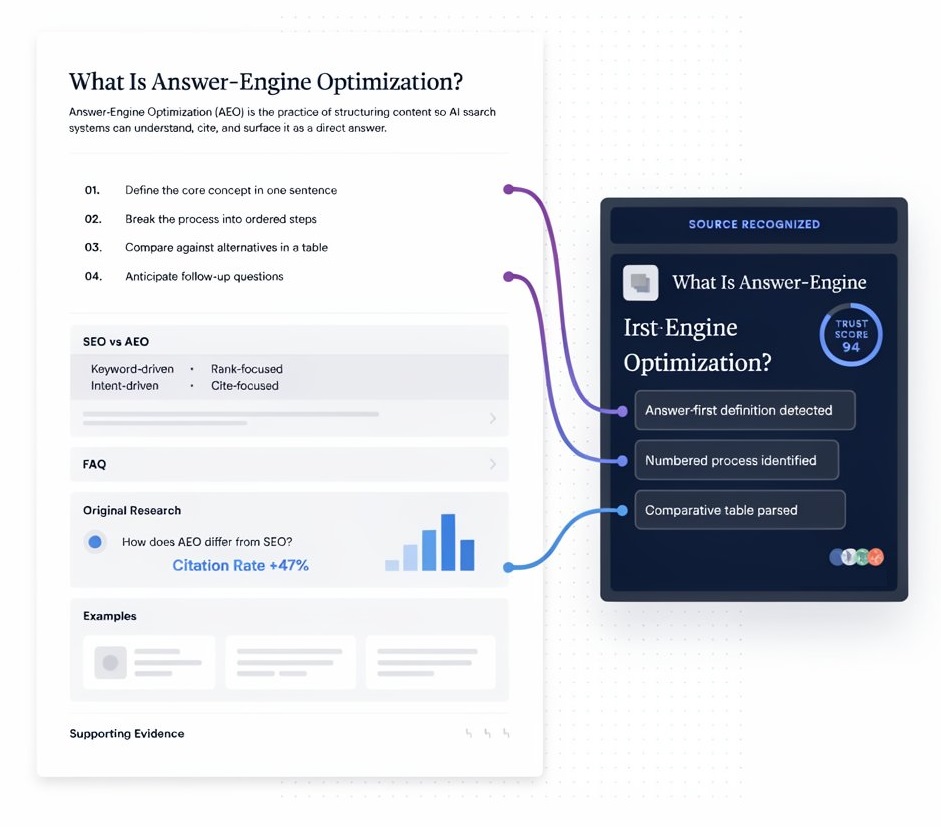
Start with an answer-first structure.
If a page targets:
“What is technical SEO?”
Don't spend 500 words introducing the topic before defining it.
Answer briefly, then add details.
For example, "Technical SEO improves website structure for better search engine crawlability, indexability, understanding, and serviceability." Then cover its importance, components, and common issues.
This helps users and search engines access relevant information easily.
Use structured information
Useful formats include:
- Numbered steps
- Bullet lists
- Comparison tables
- Definitions
- Pros and cons
- FAQs
- Original data
- Clear examples
- Evidence to support claims
The objective isn't to simplify content.
Its goal is to make your most important information easy to find while still offering depth and trust that boost conversions.
Build pages around related questions.
Don’t create lots of thin articles for every keyword variation. Build comprehensive resources that cover the full topic.
For example:
Shopify SEO Guide could cover: technical SEO, collection pages, product pages, internal linking, schema, Core Web Vitals, content strategy, AI search, and measurement.
This approach gives you a stronger content hub than dozens of scattered, disconnected pages.
Recovery Strategy #2: Redesign Content for High-Intent Clicks
You don't necessarily need to recover every lost click.
You need to recover the right clicks.
AI overviews often answer basic questions. Your job is to give users a clear reason to visit your site anyway.
That means going beyond generic answers.
Add information that requires deeper evaluation.
Depending on your business, consider adding:
- Pricing information
- Case studies
- Original research
- Templates
- Product comparisons
- Screenshots
- Examples
- Downloadable resources
- Detailed methodology
For a B2B SaaS company, an article explaining “What is CRM software?” may attract awareness traffic.
But a page comparing CRM implementation approaches, costs, migration considerations, and integration requirements can capture much stronger commercial intent.
For an e-commerce site, a generic “What is a winter jacket?” article may have limited conversion value.
A detailed buying guide comparing insulation types, weather conditions, fit, materials, and specific products can move the visitor closer to a purchase.
Turn every informational visit into a clear next step toward conversion.
Every high-value content page should answer:
What should the reader do next?
That might be:
Read → Compare → Calculate → See examples → View product → Request consultation
Instead of just thanking readers for their time, direct them to the next step to help them become a lead or customer.
Recovery Strategy #3: Strengthen Technical SEO and Structured Data
AEO isn't a substitute for technical SEO
For search to understand and cite your pages, technical accessibility is even more significant today.
According to Google, pages must meet standard technical requirements, be indexed, and be eligible to show with a snippet to qualify for AI features.
Check:
- Indexability
- Canonicals
- Robots directives
- XML sitemaps
- Internal links
- Page rendering
- Mobile usability
- Core Web Vitals
- Metadata
- Structured data
Use schema that accurately describes the page.
Depending on the content, relevant structured data may include:
- Product
- Article
- FAQPage
- HowTo
- Organization
- BreadcrumbList
Only use schema that accurately reflects the information on your page. Don’t add markup to chase a search feature.
Google's guidance also underlines that structured data should be accurate, follow the relevant guidelines, and be validated.
Shopify vs. Webflow: What's Different?
The recovery principles are the same, but implementation can differ significantly by platform.
For Shopify
Prioritize:
- Product-page differentiation
- Collection-page content
- Product and collection internal linking
- Product structured data
- Variant strategy
- Buying guides
- Product FAQs
- Category-level search intent
- Customer reviews and trust signals
Avoid having many similar product pages compete for the same keywords. This reduces your visibility and may lower conversions.
Your collection pages can give broader category-level context, while individual product pages should answer product-specific questions.
If you’re migrating platforms, make SEO part of your migration plan from the start. Waiting until after launch puts your traffic, leads, and revenue at risk.
For Webflow
Pay particular attention to:
- CMS field layout
- Metadata templates
- Canonical URLs
- Internal linking
- Collection architecture
- Schema implementation
- Indexation controls
- Content hubs
A well-designed Webflow CMS lets you scale content productively. But don’t let automation create duplicate or thin pages that hurt your SEO and conversions.
Recovery Strategy #4: Diversify Beyond Traditional Organic Search
One of the biggest strategic mistakes is treating Google traffic as the entire growth engine.
Search is changing.
Discover your brand through:
- Google Search
- AI Overviews
- Google AI Mode
- ChatGPT
- Perplexity
- YouTube
- Reddit and communities
- Partnerships
- Direct traffic
- Branded searches
The goal isn't to abandon organic search.
The whole idea is to depend less on any single channel for leads and revenue.
Build branded demand
A branded search is harder for a generic AI answer to replace because the user is specifically looking for your company.
Build content that gives people a reason to remember your brand:
- Original research
- Proprietary frameworks
- Case studies
- Expert commentary
- Unique tools
- Industry benchmarks
- Strong opinions backed by evidence
When people search for your brand by name more often, you rely less on generic keywords to bring in new business.
Change the KPI conversation.
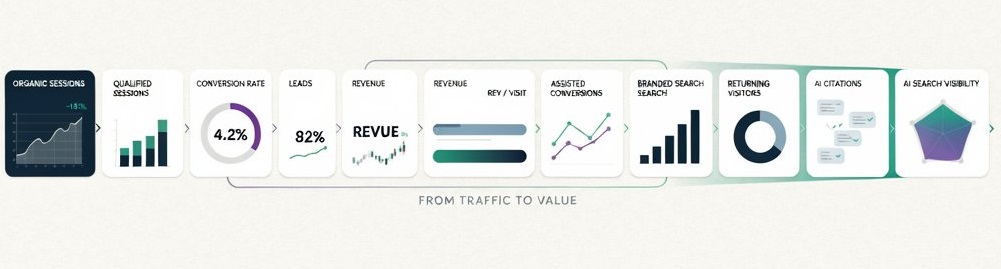
Don't report only:
Organic sessions
Also track:
- Qualified organic sessions
- Conversion rate
- Leads
- Revenue
- Revenue per organic visit
- Assisted conversions
- Branded search growth
- Returning visitors
- AI citations were measurable
- Visibility across AI search experiences
If your traffic drops by 20% but your qualified leads stay the same, your SEO is still bringing in results for your business.
But if you see a 10% traffic drop and a 40% revenue drop, your strategy needs immediate attention.
A Practical AI Overview Recovery Checklist
Don't give up on your SEO traffic just yet; ask yourself:
Search performance
- Are rankings really dropping?
- Are impressions rising while CTR declines?
- What are the queries with the highest CTR compression?
- Are commercial queries affected as much as informational ones?
AEO
- Does the page answer the main question quickly?
- Are key facts clearly structured?
- Does the page include original information?
- Could a search engine easily identify the core answer?
Content quality
- Does the page offer something competitors don't?
- Do examples provide specific and useful information?
- Does it focus on readers or search engines?
- Does it show real expertise?
Conversion
- What would be the logical next move?
- Does the page capture commercial intent?
- Are CTAs relevant to the visitor's stage?
- Are leads and revenue being measured?
Technical SEO
- Does the page contain a list of keywords?
- Do you believe the canonical is correct?
- Do internal links have good strength?
- Does structured data provide the correct information?
- Do you have any duplicate URLs?
Diversification
- Are you building branded demand?
- Are you investing in email, social, communities, partnerships, or video?
- Do you track new ways people are discovering AI?
Conclusion
The new goal isn't just about getting more traffic. It’s search visibility that’s more valuable and generates leads and revenue.
AI Overviews have changed the economics of organic search.
So don’t panic or make knee-jerk changes.
Don’t just publish more articles for the sake of it.
Don't abandon SEO.
Don’t chase every new AI acronym or trend.
Instead, build your search strategy around four proven principles:
Diagnose the loss.
Find out if you’re dealing with ranking drops, demand shifts, technical issues, or CTR compression from new search features.
Make your content citation-worthy.
Give clear answers, offer original value, organize information logically, and reinforce the basics that Google already advises.
Make clicks more valuable.
Move beyond generic informational content toward evaluation, action, implementation, and conversion.
Diversify your acquisition engine.
Build branded demand and other channels so your business isn’t dependent on a single Google click.
The brands that adapt fastest aren’t always the ones producing the most content.
They’re the ones creating content worth discovering, citing, clicking, and acting on.
Ready to find out what's actually causing your traffic decline?
If your rankings look healthy but organic clicks and conversions are falling, a page-by-page diagnosis can reveal whether AI Overviews, content quality, technical SEO, search intent, or conversion gaps are driving the drop.
Book a free AI Overview & SEO Recovery Audit to identify your biggest traffic opportunities and get a practical AEO, content, and technical recovery plan tailored to your website.